There are 5 business needs that we see happen about this time every year. Smart business leaders and owners know strategic branding and proactive marketing grows the top line. This is especially important in the 4th quarter of the year, when planning for next year comes into play. That’s why our clients raise their hand and ask Front Porch Marketing for help. They keep up with what their customers want and then they stay ahead of the competition by delivering it. And we joyfully help them. This past month of October, we’ve executed quite a range of marketing projects.
1. Full service marketing help for their 5 business needs.
C-suite executives looked to us to guide marketing strategy and execute pretty much everything on this list, because of empty seats on their team. We operate as “the marketing department” for several of our clients who have small teams and big needs.
2. Targeted, paid digital strategy.
From SEO and SEM to paid search, through display, shopping and gmail ads, our clients know how important search is for customer and client acquisition. We set up quite a big of this type of digital marketing in October.
3. Website refresh.
Q4 is the perfect time to refresh your website and quite a few of our clients are in the middle of a site refresh. Keeping branding fresh and relevant. Making sure that sites are optimized for content. Maximizing and streamlining customer journeys.
4. Paid email marketing.
From platforms like eTarget, MailChimp, HereFish, Zoho and ActiveTarget. List acquisition, cleaning and segmenting. Creating emails is the part you see…but list preparation and optimization is the key to more targeting customer acquisition. Email marketing is not slowing down anytime soon from what we’ve seen in October.
5. 2022 planning for next year’s 5 business needs.
Accessing 2021 marketing activities to date, and with phone and online client and customer surveys, we’re right now developing strategies, messaging, timelines and budgets for 2022. October has been busy getting our clients prepared for growth and smooth sailing the next year. This is absolutely one of our favorite things to do – setting the stage to help our clients’ business grow.
We also love sharing client happiness. This week, when delivering a final logo design, brand guidelines and collateral materials, a client emailed us, “Those goodies are like Christmas, seriously a sense of joy just washed over me.” And that brings us joy too. The season of joy doesn’t come just once a year for us, it’s all year long because we get to work with business owners who love what they do as much as we do.
A winning marketing campaign is all about selecting choice plays from your marketing playbook to best reach a specific goal. It is a single piece of your overall marketing plan, not the whole playbook. You wouldn’t run all of your plays against every opposing team. Marketing campaigns are tailored to individual need(s), too.
Why do you need one?
Any brand looking to launch a new product or site, announce an expansion, celebrate a milestone or grow interest in a specific event can benefit from a marketing campaign.
One of our clients is a well-known and respected local healthcare facility. They needed to market an expansion project three years in the making. Children and their families are their focus, so they requested a game or an app. They wanted to reach more than just their internal audiences (patients and families) though. To reach external audiences (the community at large, donors, etc.), they really needed more than a single marketing tool. They needed a full court press campaign.
How do you create a winning campaign? Here are 5 key components to success:
Determine your why. What is your goal? Is it a successful event, increased sales numbers, greater foot or website traffic, or making your brand more recognizable? Once you know the endgame, you can start figuring out how to play it to win it.
Scout the roster. Who is your target audience? What are their likes, dislikes, and the mediums they are most responsive to? If you don’t know who is playing the game, you’re going in behind in the count.
Choose the right venue. Oftentimes when you think of marketing campaigns billboards, mailers or TV ads come to mind. It can be any (or all) of those, but it can also be so much more. Perhaps social media or e-mail marketing is a better choice. A combination of things may score the most points. It is all about appealing to your audience in the arena(s) they know best. Marketing campaigns are not one-stop shops.
Timing matters. If you are launching a product, you want to play the long game to develop interest beforehand and keep it rolling long after. This was the case for our client. They needed a three-year campaign to match their three-year expansion project. If you have a major event scheduled, then you have a “big game” situation. Hyping it up beforehand and making sure to have the right crowd in attendance means you have to watch the clock.
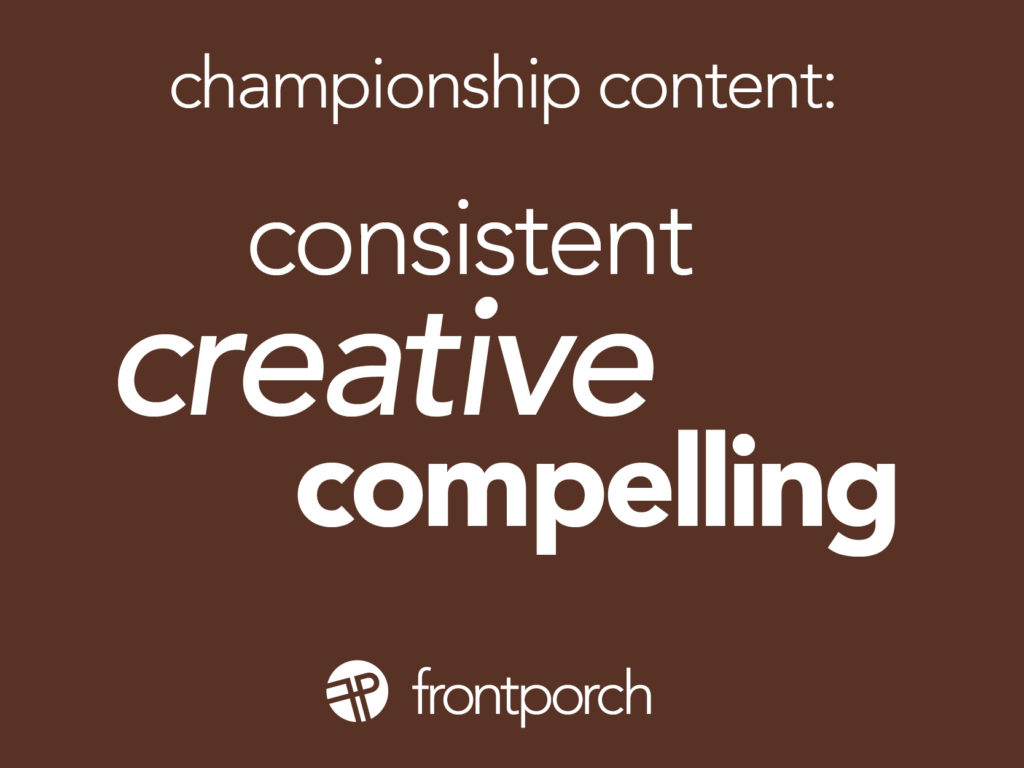
Create championship content. Remember the Rule of 7 and make sure your content is consistent, creative and compelling.
A winning marketing campaigns is all about learning what makes your crowd go wild. We’d love to join your team and help you plan for the dub.
We have put together a must-read list of ’10 marketing books for 10 years’. Front Porch Marketing turns 10-years-old this month! Marketing has been constantly evolving over the past decade. As an all-remote, agile marketing company, we’ve evolved right along with it. But sometimes it can get hard to stay on top of all the changes.
That’s why we turn time and time again to the experts in our marketing books. In honor of our 10th anniversary, we rounded up 10 must-read marketing books that we think demonstrate positive perspectives and practical advice.
Books are one of the easiest ways we know to dive into new marketing topics. Then we can grow our practice and application of that knowledge. We hope these suggestions offer you some inspiring new perspectives on the ever-evolving world of marketing and help you stay on top of all the changes. If we can help you with your marketing challenges in any way, please ask!
Must Reads: 10 Marketing Books for 10 Years – our marketing reading list for 2021
This is one of our favorites. Seth teaches you how to frame your marketing messages so that your customers will willingly accept them. Permission marketing enables brands to cultivate long-term relationships with customers. This builds trust and ultimately increases the likelihood of making a sale. Seth challenges you to only talk to people who are already raising their hand asking to speak with you. Then he shows how this customer is your most valuable one.
This one is near and dear to our own Front Porch Marketing mantra. Adam – an award-winning researcher and professor – says that the key to success is not ambition or greed, but thoughtfulness. Good guys will indeed finish first in Adam’s worldview. And he gives ample evidence and example to prove it.
Karen leads with proven and practical digital strategies to boost client leads. She shows you how to increase email click-through rates and generate higher opt-in rates. She shares how to assess your current digital marketing channels like SEO, email and PPC and optimize them for better results. And with an emphasis on small business, this book serves as a handbook to make the most of every marketing dollar.
Tyrona, a Google marketing alum, offers valuable information on attracting and converting customers using inbound marketing. With SEO, blogging, social media and email marketing as your toolkit, follow Tyrona’s step-by-step system to set up and deliver an inbound marketing plan. Turn strangers into visitors, visitors into leads, leads into customers and customers into loyalists using minimal resources.
The authors of this book base their thinking on a study of 150 strategic marketing moves spanning more than 100 years and 30 industries. They show you how to build lasting success from creating a new market space (a blue ocean) in which there are no competitors. This book represents a ground-breaking new perspective because dominant marketing thinking for the past 25 years has been concerned with creating revenue by taking market share away from a competitor.
Miri helps brands understand the why and how of infusing their marketing strategies and tactics with an authentic voice that will resonate with consumers. This book serves as a template for helping brands discover that voice, and their story, and structuring them to share insights with their customers.
Joe and Robert – the founder and the Chief Strategy Advisor for the Content Marketing Institute – share bold thinking putting content at the forefront of marketing. They’ll help you create value for consumers and instill loyalty in your followers. This book outlines how to look at marketing as a profit center instead of a cost center. Content marketing helps brands own media instead of purchasing it.
Joe, the former head of strategy at social media giant Reddit, offers effective engagement strategies on social media through the lens of human psychology, neuroanatomy, biology and anthropology. Using more than a decade of experience, he explains consumer behavior in social media in terms of how the different social platforms each represent different mindsets: the Id, the Ego, and the Superego.
From the MIT Press, Anindya draws from his extensive research in the US, Europe and Asia using real-world examples from global companies to explain consumer behavior in the mobile realm. He identifies nine forces that shape consumer behavior and how to tap into those forces to influence shoppers and maximize brand opportunities.
Before jumping into content marketing, step back and assess what the core business problems are that content marketing can solve. Steve offers a guide to identify and define those problems. Then he helps you understand where content marketing can add the most value for your brand. Content marketing is more than just writing and design, and Steve teaches better techniques for distribution, measurement and optimization.
Let us know if you’ve read some of these, or have others that are your favorites! Please share your favorite marketing books in the comments to make our list more complete.
What is Content Marketing, and how do you win at doing it? How do you know what steps you need to take? Last month, we talked about doubling down on your brand – envisioning what your brand stands for, evolving your brand to meet your company’s needs today and emerging stronger in 2021.
This month, we’ll give you some pointers on taking your shiny new branding out into the world – with Content Marketing – for the win. What are the places that consumers will see your brand and interact with it? You’ll want to read thru to the end, because we’re going to tell you exactly what steps to take in this month’s extension of our Marketing 101.
Once your company has been thru a branding exercise, you’ll leave with your game plan and you’ll know what to do next. You’ll have your target nailed down, your brand’s personality defined and know exactly what category of business you can excel within. The first step once you’ve done this important branding work is your visual identity.
Ready, Set, Marketing – Your Brand’s New Logo
Commission an easy-to-use logo that works in many places. Your logo will be on your website, your social channels, your advertising and even on print work like business cards and brochures. Your logo should be simple, look good large or small. It should be easily used in black, white, and any brand colors you designate.
We’ve designed half a dozen new logo systems this past year, and while they are all quite unique to the company they’re designed for, they all have one thing in common – flexibility.
Your Brand’s New Website
If your company has a website, is it responsive, meaning does it work first and best on mobile but also on tablet and desktop devices? Modern websites need to be built with functionality for users top-of-mind.
This is called User Experience, or UX. How your customer goes thru their journey on your website should be carefully considered to make their experience as simple and rewarding as possible.
Next, your website should incorporate other important factors like Search Engine Optimization (SEO), which helps search engines like Google find your website easily. Google can then present it as a choice when consumers are searching for a business like yours. Using keywords and key phrases can help search engines determine how helpful your site is answering their questions.
Location is also a very highly weighted factor for search engines as well. If you are, for instance, a local restaurant trying to attract customers in the surrounding area, then this type of information should be of utmost importance when designing your new site.
Your Brand’s New Blog – the Starting Line of Your Content Marketing
Once you’ve built your website, keep your site content fresh. One of the most important parts of a new website is the blog. This is the place where the Content Marketing race starts. Regularly updating your blog means Google will keep revisiting your site to catalog the new helpful information you are sharing to “index” it for customers to find in search.
Blog posts are like a regular newspaper column for readers. They can subscribe to receive your news. They can make comments on your article at the end of the article. We write blog posts on topics relevant to our customers’ businesses for their website. This helps them to both build relationships with current customers as well as attract new potential customers.
Help solve people’s problems. Make this key in your blog content. Also, posting on a regular basis is equally important.
Your Brand’s Content Marketing Outreach
Think of your new site as your business’ virtual storefront. It’s your home base. Your social channels – like Facebook, Twitter, Instagram and LinkedIn – and other tactics like email marketing, Text Message Marketing are in essence, not just your advertising, but your chance to talk to your customers 1-on-1. An opportunity to develop a relationship with them. Each of these tactics has a specific use for a small business – every channel is not appropriate for every small business.
Winning in Email Marketing
Content marketing’s main ingredient is email. First, email marketing shares insider information with your best customers. After all, they opted in to receive this email newsletter from you. For instance, retail stores could offer special discounts, special not-on-the-website items, and special gifts-with-purchase to their favorite customers – which in the digital world would be their email subscribers.
For a restaurant, email marketing can announce a dining event, or a big menu change. Or a business service could announce open jobs, industry news that would affect their customers or tips and tricks to get the most out of their service.
Winning in Social Media
Social media, as a content marketing winning tactic, promotes blog posts, events, promotions, products or simply build conversation and relationships with different customers.
Our restaurant example, for instance, would want to rely heavily on Facebook, as that is the place to grow a local community – interacting with actual people who rely on their business, garnering reviews from customers, and posting events that their businesses is hosting.
But, an interior designer however, would focus on Instagram, as their clients might be all over the country, and consumers on Instagram are interested in all things beautiful. Hashtags #likethisone at the end of an Instagram post help customers find your business, much like the old card catalog at the library could help you find books on a specific topic.
Use Twitter for getting and sharing news with industry peers to establish your voice of authority. Are you an expert real estate broker? Then, share industry news in your category and give your take on any particular article. Follow reporters who work on your segment of business and interact with them when appropriate to demonstrate your expertise, making you a viable option for quotes in articles in the future.
Further, on LinkedIn, a non-profit foundation could share their quarterly goals, fundraising efforts and events, and results to a business audience of potential donors and board members.
Your Brand’s Content Marketing Win
Start with your brand. Establish a strategy for your content marketing for the win. Implement your tactics. Understand that marketing, and especially digital marketing, is a marathon with no finish line. How you run that marathon matters. Keep at it, perfecting the steps you take a little at a time. But start by taking that first step in content marketing for the win.
If you’re like a lot of businesses this year, you threw out your 2020 marketing plan and have been in triage mode for six months. Q4 is the perfect time to re-evaluate your company’s marketing plan to include a good marketing planning outline and process, messaging, strategies and brand.
This year’s best laid marketing plans were most likely laid to waste in the second quarter. It’s now Q4 of a very weird year – speaking from, well, every point of view – and everyone is working under the guise of not knowing what is coming next or when. Some businesses are continuing to just execute 2020 marketing strategies with messaging that is not currently relevant to growing their top line or their bottom line. Stop reacting and get proactive with your brand.
Typically, clients reflect and plan ahead this time of year, and this Q4 should be no exception.
In fact, we recommend doubling down on the planning. This year though, planning may look a lot like pivoting for most businesses. There is very little business-as-usual going on, and your company’s business plan should reflect that fact.
We are working with clients that are facing different year end results – from more than 75% decline in sales, to flat, to having the best year ever. We have clients who’s marketing plan has them pivoting completely and launching new brands, born of the new normal or a long-held dream. But the one thing all of our clients have in common right now is that they are planning in order to be able to continue to pivot if need be. They are ensuring that their future strategies will be on-brand even if the content has to change.
Now is the perfect time to step back from your business plan and take an objective perspective on your company’s state of affairs.
Is your brand’s marketing plan going in the right direction? Do you need a more focused or broader message? Are your communication strategies getting you in front of the right customers on the right social media channel? Is your brand voice in tune with the state of the world? Know who you are, what you stand for and how to communicate that mission to your customers. What is your highest and best use? When you have a plan, this is how you can frame all of your future content – even if it keeps changing.
Plan ahead to pivot.
Planning a marketing infrastructure to put in place now and building on it through Q1 and Q2 of next year can help pivot your brand toward a new goal, refine your mission and elevate your relevancy. Have a plan in place to be able to address the unknown needs of your customers as they arise in 2021. You don’t necessarily need the answers now, but you need to have a plan to be able to answer the questions your customers will have. Your marketing plan for next year should include key messages, strategies, a budget, timeline and content calendar through Q2 of 2021 to carry your company into Q3. Spend your marketing time wisely this quarter to build the brand you’ve always wanted to become next quarter and beyond.
Nonprofits work hard for little money and recognition. With few resources, you’re doing the best you can. But don’t think for a second that just because your organization is a nonprofit that you can’t have great marketing.
Remember, nonprofit is a tax status, not a case for support. Being a nonprofit alone is not a reason for anyone to give. Nonprofits must tell the public about the good they are doing and how people can help.
Here are 5 common nonprofit marketing mistakes and how to fix them:
Mistake #1: Not Participating in Social Media
The point of social media is to be social. Too many nonprofits post only about themselves, follow only a few accounts, do not respond to comments, and ask without giving in return.
This is the equivalent of meeting someone at a party who only talks about themselves, talks your ear off for 20 minutes, and then asks for $50.
Don’t be that guy.
Here is a good rule of thumb to remember when it comes to social content:
A third of your social content should promote your organization, converts readers and generates donations.
Devote a third of your social content to sharing ideas and stories from thought leaders in your industry or like-minded organizations.
A third of your social content should be fun stuff to show that there are human beings behind your social media handles.
Mistake #2: Forgetting Who Your Audience Is
Too often, organizations market to themselves. They only consider what appeals to them and not their supporters. Step outside of your perspective and think long and hard about your audience.
Are your supporters older, younger, parents, young professionals? Are they more likely to respond to digital appeals or direct mail? What do they care about the most – saving time, professional development, kids, the environment, education, social issues? Put yourself in your supporters’ shoes.
Stretched logos, incorrect brand colors, spelling errors, pixelated photos – if they happen once or twice, it’s a simple mistake. If they happen all the time, it makes your organization look homespun at best, or unprofessional worst. And that can erode trust.
Mistake #4: Too Much Text
As they say, a picture is worth a thousand words. And a thousand words alone is, well, not something anyone wants to read.
Your supporters lead busy lives. Take a closer look at your content and figure out where you can tighten your copy.
Mistake #5: Boring Photography
Scott Kirkwood, former editor-in-chief at the National Parks Conservation Association magazine, put it best in a HOW Magazine article:
“…if you helped the nearest national park receive money for a new building, don’t show a photo of that building – it’s a building. Think about how that building will change the life of a visitor. Will the park be able to offer more bird-watching programs as a result? Great. Show a photo of a bird.”
Don’t think that just because your organization is a nonprofit that you can’t afford great photography. The latest smart phones can take great pictures and with a few tutorials, you could be well on your way to taking great photos.
Show photos of the people, animals, environments, etc. helped by your programs.
Show, don’t tell.
You’re trying to do good on a shoestring budget and a skeleton staff. We get it. Its understandable if this seems overwhelming. Great marketing is a constantly moving target that poses a challenge for many organizations.
If you want to talk about your organization’s marketing challenges, give us a call.
Blogs. Social media. Video. White papers. Infographics. All these things, and more, are content and can be used in content marketing. But what is the point of generating all this content?
The point is this: in an increasingly fractured media landscape, building an audience and a community around your company is one of the few ways to directly reach consumers. By giving them something of value, they will give you some of their attention.
Content marketing is about building trust. If consumers trust your company, they will be more likely to buy from your company.
Today’s consumer is used to doing their own research before they buy. According to a 2016 Demand Gen Report, 47% of buyers view 3-5 pieces of content before engaging with a sales rep. Wouldn’t you rather have one of those pieces of content be from you?
The Marketing Funnel is Changing Shape
The marketing funnel isn’t so much a funnel anymore as a flywheel. This Forbes article excerpt explains it best:
A change in mindset and a library of high-quality content will replace this traditional funnel with something more sustainable (and effective). The funnel is becoming more of an ongoing cycle that prioritizes continuous engagement over transactional relationships. This increased focus on nurturing, especially post-sale, makes customers more likely to stay with you or buy again — and more likely to give recommendations to friends and colleagues.
With content, you can transition your brand from vendor to partner. To be honest, someone else in your space can almost always come in and undercut you on price. But when you continuously engage your clients, build lasting trust, and form genuine partnerships, you’ll have much greater staying power.
The Oldest Content Marketer on the Block
Content marketing has been around for as long as there has been, well, content. One of the earliest, and in my opinion, one of the best content marketing examples is The Furrow magazine produced by John Deere.
What started out as an advertorial-driven publication turned into a beloved resource for generations of farmers. Today, The Furrow is a story-telling vehicle, with great photography and advice on how farmers can run their businesses.
And, there’s not much actual mention of John Deere. The Furrow is happy to be a trusted source for farmers, and in exchange, farmers let John Deere into their homes.
Fun With Fireworks
You don’t have to be the flashiest company on the block to use content marketing. Case-in-point, high-end cooler company Yeti. From the beginning, Yeti forged their own marketing path.
In addition to targeting “prosumers” with sponsored programming on hunting and fishing television stations, Yeti created a series of short video clips that put their product to the test. They pitted their coolers against a professional wrestler, a slingshot, and even fireworks.
Content marketing is usually educational. But it can be fun, too.
Canva is another great example of content marketing that takes care of the customer rather than pushing them through a funnel. Canva is a graphic design app that also publishes helpful content through their Design School blog and social media. They are a resource for their customers and earn their trust.
I used Canva when I was working in a job where I did not have access to Adobe products (the industry standard when it comes to graphic design.) I also tried out different software alternatives. Truthfully, if the Canva software didn’t work as well as it does, I might have gone with one of their competitors. But, Canva works well and it’s a great resource. So, I went with them.
Yes, eventually I moved on to Adobe products. But it certainly wasn’t because of price (graphic designers often call it the “Adobe Tax”). For a long time, I relied on Canva for graphic design basics and how-to information. And now, I tell anyone and everyone who needs graphic design software cheaply to try out Canva. I am no longer their customer, but I am an advocate for them.
Content marketing is a slow roll. It’s like leaving a bread crumb trail for consumers to follow. Spread those bread crumbs around, make them irresistible. Everyone wants to be remembered, so tell your story.
To go along with our 8th Anniversary, which we are celebrating this month, here are eight marketing trends that are fast-becoming marketing must-haves. Are you taking every opportunity to build your audience?
Are you building your audience?
1. Personalization
Personalization can take on many flavors. It can be as simple as including your customer’s first name in the salutation of an email. Or, a company can be very intentional about their website and lay out an easy-to-follow trail of digital breadcrumbs.
You don’t need to turn your supply chain inside out but do think about how you reach your customer at every touch point and ask, is this made for them?
2. AI
Speaking of personalization, Artificial Intelligence is going to make even more personalization options available. In fact, it already is – Amazon is a perfect example. When a customer logs into their Amazon account, the landing page is customized for them based on their past purchases and viewing history.
Build your audience in real-time.
3. Live Streaming
Even in our hyper-connected world, people still long for connection. I think this partly explains the popularity of live streaming (also called live video). Conducting live streams with comments enabled can go a long way in building a relationship with your audience.
4. Visual Search
Human beings are visual by nature. So, it makes sense for people to want to search visually as well as with words. And the technology to do so is getting better and better.
Pinterest is a powerful example of this trend. For an interesting account of their pursuit of visual search technology (it all starts with an avocado, because of course it does), click here.
Hello … is it me you’re looking for?
5. Voice Search
As we have talked about on this blog before, voice search is fast becoming a part of consumers’ everyday lives. Forty-one percent of adults use a voice- activated personal assistant at least once a day. Optimizing your website for voice search will become increasingly important.
6. Purpose & Emotion
The adage “people buy with their emotions and assign reasons to their actions later” is true. Nike, Tesla, Facebook. For better or worse, these companies have showed their purpose through their actions over the years. And customers have reacted.
What emotions do your customers associate with your company? What is your company’s purpose?
Retail is dead. Long live retail.
7. Experiential Commerce
Much has been made of the retail apocalypse. But, as TechCrunch argues, retail might not be experiencing The End so much as an inflection point.
Many wildly successful e-commerce businesses have opened physical stores in recent years – Amazon, Warby Parker, Casper, Glossier. It’s all about creating a seamless experience where a business can court a customer little by little. Retail stores are showrooms and experiences unto themselves, where customers can try before they buy.
Content marketing isn’t going anywhere. The media market is fragmented, everyone is their own publisher. Now is the time for companies to build their own audience.
Pardon our mess … we’re building an audience.
2019 will be all about a better customer experience with personalization, automation and AI-powered technology, so you need to be sure you are producing custom content to engage your targeted audience. Whether you’re considering incorporating these trends or you’ve already implemented and are evolving your use of them, we are here to help you incorporate them into your marketing plan.
Personalized marketing is all about connecting the dots – data and content – based on consumers interests and preferences. Data collection and analysis allows for strategic deployment of individualized content to target audiences. “Customers have more choice than ever before, so we have to ensure we’re meeting their needs in real time, on-demand and personally relevant ways, both online and offline,” Mark Sciortino, VP of brand marketing strategy and planning, Walgreens, relayed in 2018.
Knowing their sensitive information is protected makes customers more comfortable with providing personal information. In return, they should receive more personalized experiences upon subsequent visits.
Increased Brand Loyalty
When consumers provide information and data, they expect to be treated as unique individuals with specific preferences. Dedicate time and resources to implement successful personalized marketing strategies. The result will be a competitive advantage in both brand loyalty and customer satisfaction.
Inflated ROI
If your automation technology is on point, you can easily identify individual customer preferences. Capitalize on it with customized content across channels online and offline. This will result in more sales opportunities. Coca-Cola’s Share a Coke campaign used common first names to attract millennials. That personalized campaign was the first time in years Coca-Cola grew their sales.
Personalized marketing campaigns require you to connect the three “C’s” of content with the three “C’s” of customization. You must know – and connect with – your audience. To know them is to love them by generating content personalized to them.
Collection
To create personalized marketing, you have to know what matters to your target. That starts with collecting data about them which is relevant to your brand. Real-time collection and analysis of data allows you to consistently evolve your marketing strategies to customers’ ever-changing behaviors. For example, if you are marketing a restaurant, your data collection would include location, demographic, and transactional data.
Creation
For your data collection to be beneficial, you have to utilize the collected information to create relevant content. Data collection allows you to create targeted and customized email marketing, social media marketing, video messages (one reason automated technology is key), and individualized product recommendations. In fact, 2015 research showed that personalized email campaigns received 29 percent higher email open rates and 41 percent higher click-through rates than ordinary emails.
Connection
Connection is built through authentic interactions. Personalized marketing allows you to connect individually and in community with your audience. You can show your human side (social media engagement or working reply-to email addresses). It also allows you to capitalize on consumers FOMO (fear of missing out) by showing how many people may be looking at the same product, how many of an item remain in stock or how long an item may remain on sale.
As with any marketing campaign, there are challenges to achieving these goals. In personalized marketing, the two main challenges to overcome are:
Consistency. Consumers are interacting with brands across a number of channels, including email, social, mobile, etc. Each interaction with your brand must be consistent at every touch point.
Time and Resources. To collect the right data, companies must utilize the right technology. Analysis of the data to create relevant content on a constant, evolving basis across multiple channels is key. This takes a significant number of hours and a significant chunk of manpower and monetary resources.
We would love to be a consistent resource to help you connect all the dots on your brand’s personalized marketing campaign.
In 2019, social media marketing is an essential tool for developing a connection with your audience. In some ways, social media marketing is similar to online dating. You are courting your audience with social media, and a connection won’t develop by being overly promotional with your posts.
Successful social media marketing requires an investment of significant time (and resources). Your investment can pay dividends, but it requires planning. Developing strategies with clearly-identified goals and target audiences is key. But avoiding common faux pas is equally as important.
Seven of the (many!) dos and don’ts for social media marketing
Be social. You have to put yourself out there, so don’t be nonexistent on social media. You can’t influence anyone if you have no profile.
Be interesting. Know Your Audience. You want to pique and maintain viewers’ interest, so post varied content they will find interesting and valuable. Don’t make it all about you by only posting promotional content.
Be genuine. If your brand is all about fun, your audience expects a certain playfulness to your social media. Don’t send mixed messages by being inconsistent in your marketing.
Be available. Social media marketing is a 24/7 customer service opportunity, so engage often and consistently. Don’t ignore posted questions or concerns.
Be a good listener. Always pay attention -and respond gratefully- to consumer feedback. Don’t ignore the negative feedback, because you can’t develop relationships by ignoring (or deleting) criticisms.
Be Aware. Use hashtags and handles to attract interest, but don’t appear desperate by using too many. Keep it effective and efficient.
Be smart. Check your content for spelling, grammar and phrasing, and correct mistakes as soon as they’re caught. Don’t be insensitive in your phrasing or messaging.
We cannot say it enough – strategy is critical.
Content is key. Consistency is key.
Social media management is customer service and poor customer service will hurt your brand’s reputation.
Unlike in dating, it is a good idea to outsource social media duties. Those of us with the experience and knowledge can create and implement social media marketing strategies that follow all the rules.
Give us a call to help influence your audience to swipe right on your brand’s social media marketing!