Category Archives: Insights

In branding, there are many processes that agencies adopt. The foundation of the models that agencies use are often centered on a brand vision or promise. After your brand’s vision and promise comes the personality or character that your brand uses to express itself, as if it were a person. Remember that inconsistency in delivering on the promise dilutes customer or client faith in the competency in your organization. Thirdly, your brand needs positioning. Call me and I’ll be happy to share more detail about this important part of the exercise.

Affiliating With Your Brand

Lastly comes the brand affiliation. What do your clients or customers want others to think about them because they are affiliated with your brand? Affiliation is key and starts with your internal team. After all, they are the closest to your brand. So if you have recently rebranded, and your current marketing partner isn’t telling you to start engaging your internal team first, you should think again about your brand’s priorities.

Branding is Alchemy

These important marketing exercises can seem like a magical process of transformation for a company. An alchemy of sorts. Successful branding makes everything you do make sense, and gives you a clear path of where to go next. So who are we to fight the alchemy?

In order to deliver consistent messaging, business leaders and owners need to remember a few things when they rebrand. First of all, you, dear business owner, cannot create your brand in a vacuum. Context matters. The market matters. And, again, we say this often as a reminder of how to come away from a brand exercise with strong results.

The Three Cs of the Branding Process

Of course, difficult conversations sometimes happen during this process. And, on the Porch, we are here for it. We believe in and practice these three pillars in our marketing: Conviction, connection and consistency. We’ve talked about these before. And we will talk about them again, and again. Because building your brand around these pillars works.

Conviction

We know business owners and leaders have conviction about their company and their brand. It’s the passion, the energy and the will to be successful. It’s a growth mindset. When you are convicted about your brand and absolute about a growth mindset, the magic will happen. When we work with companies, we talk on their conviction as our own. We want the success to happen as much as they do.

Connection

Connection is about building a space where communication is genuine with branding and connection to your audience. It’s about reaching your customers and clients on a 1-to-1 basis. Meeting their needs. Solving their problems.

Remember, you are not your customer or your client. Your personal preferences may not be the needs of your customer. One of the hardest things to do for a business owner is to step out of their own shoes into the shoes of their customers and clients. Recognize and meet their needs. Don’t talk at them, talk with them. Connect.

Consistency

Consistency is where we see sometimes really strong business fall short. The business leaders want to jump in and get hands on. Maybe they LOVE the creative side of the business so they want to design their own logo, letterhead, website etc. And, the result in our several plus years of experience, is that this is a disaster.

I myself love the creative side of the business; however, I am not a graphic designer, so I let the trained professionals do their job. If you’re a business owner thinking about consistency yet trying to do parts of the branding process that are out of your wheelhouse, question yourself: Is this the right way for me to spend my time?

Growing Your Brand

On the Porch, we are so grateful for business leaders and owners who are open to defining their look and their voice with us. We love working with owners and leaders who want to grow their brand beyond their comfort zone, realizing business success comes from this eye-opening, defining process. Together we can accomplish great things throughout the branding process and into all the marketing work beyond that!


Stepping onto the “Front Porch” for the first time, I knew I was entering a space dedicated to storytelling and strategy. But as I look back on my internship, I realize that the most impactful lessons didn’t come from a textbook; they came from watching how brands live and breathe in the real world. As well as personal branding and connection.

Marketing isn’t just about the “what” it’s about the “who” and the “why.” Reflecting on my time here, three things stand out as the foundation of everything I’ve learned: the intentionality of branding, the depth of brand loyalty, and the necessity of knowing your audience. 

Branding: More Than Just a Logo 

During my time at Front Porch, I’ve seen firsthand that a brand is a promise. It’s the consistent thread that runs through every social media post, every email, and every client interaction. A brand isn’t a static image; it is a living reputation. 

I’ve learned that successful branding requires: 

  • Vulnerability: Being honest about a brand’s journey. 
  • Consistency: Delivering the same message across every touchpoint. 
  • Clarity: Knowing exactly what strengths and weaknesses you solve for your client. 

When a brand is built with intention, it stops being a service and starts being a solution.

The Weight of Branding and Loyalty 

We often talk about “getting” customers, but my internship taught me the importance of “keeping” them. Brand loyalty is the difference between a one-time transaction and a lifelong advocate. I’ve observed that the most successful clients we work with are those who don’t take their community for granted. 

Loyalty is earned in the quiet moments: when a brand responds to a difficult situation with grace, or when they choose quality over a quick fix. During my time here at Front Porch, I’ve realized that people don’t just stay loyal to a product; they stay loyal to how a brand makes them feel. When you stay true to your brand promise, your audience rewards you with the most valuable currency in marketing: trust. 

The Art of Connection to your Audience 

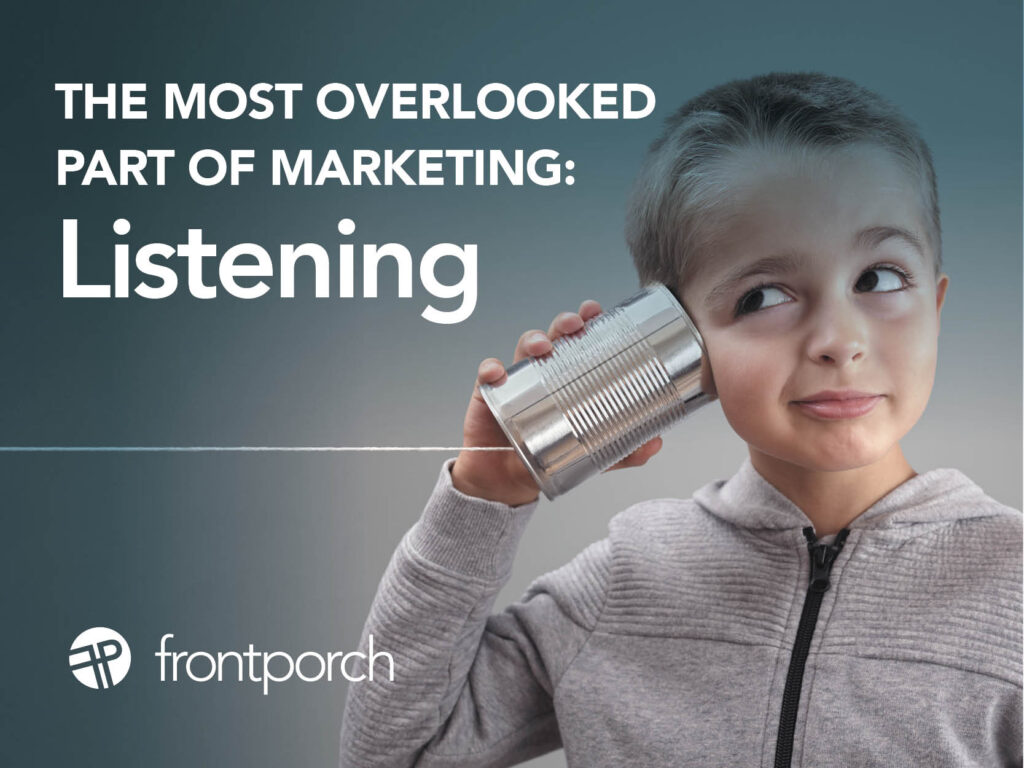
If branding is the “voice,” then the audience is the “listener.” One of my biggest takeaways from Front Porch is that you cannot speak effectively if you haven’t first listened. 

True audience connection involves: 

  • Data with Soul: Looking beyond the numbers to see the people behind the clicks. 
  • Empathy: Understanding the daily challenges and joys of the consumer. 
  • Evolution: Recognizing that as your audience grows and changes, your strategy must as well. 

Marketing is a two-way conversation. My internship here at Front Porch has shown me that the “lucky” brands are just the ones that have done the hard work of truly understanding the person on the other side of the screen. Personal branding needs the priority of connection and loyalty.

Final Reflections on Branding and Connection 

As I wrap up this chapter, I’m leaving with a new perspective on how businesses connect with the world. Authentic marketing doesn’t shout at the crowd; it speaks to the individual. 

The “Front Porch” philosophy isn’t just about business; it’s about building a space where communication is genuine with branding and connection to your audience. These are the lessons that will guide me long after I’ve left the porch. 


We’re in the middle of several exciting branding projects with clients right now, so not a day goes by that I don’t talk about at least one of the three Cs that make a strong brand — conviction, consistency and connection. Today I’m going to expand a little on consistency and what that really means.

Consistency isn’t about saying the exact same thing over and over. It’s about showing up with clarity and cohesion across every touchpoint — your website, social media, sales conversations, proposals, email campaigns, even how your team answers the phone.

Deliver on Brand Promise with Consistency

Strong brands don’t rely on one great campaign to make big strides. They build momentum through repetition and by delivering on their brand promise every single time, over time.

When your messaging is steady, your visuals are recognizable, and your voice is clear, something powerful happens:

• Trust for your brand is built
• Confidence in your message increases
• Recognition of your brand grows
• Decision-making becomes easier for your audience

Consistency Helps Turn Strategy into Reputation

Conversely, inconsistency in how a brand shows up can slowly erode trust. When the message changes too often or the experience varies from one touchpoint to the next, it creates uncertainty.

We often see companies reinvent themselves too frequently — a new tagline, a new focus, or a new look. But growth doesn’t come from constant reinvention.

Consistency is what turns strategy into reputation and demonstrates you deliver on your brand promise.It transforms marketing from an activity into business impact. And while it may not be as flashy as a big campaign launch, it remains one of the most reliable drivers of long-term brand equity and business growth.

At Front Porch, we don’t overcomplicate things. We get straight to the point. Conviction. Consistency. Connection. That’s how strong, lasting brands are built.


Artificial intelligence isn’t just transforming marketing, it’s reshaping what it means to be human in a digital world. Over the past several months, I’ve explored AI through the lenses of philosophy, business strategy, and customer experience. What I discovered is simple but powerful: AI doesn’t replace the human role; it sharpens it.

As automation accelerates, the uniquely human skills, empathy, intuition, creativity, and judgment, become even more essential. The marketers who thrive in the next decade won’t be the ones who resist AI, but the ones who learn to orchestrate it.

AI and the Question of What Makes Us Human

One of the most surprising parts of studying AI is how quickly the conversation shifts from technology to identity. When systems become predictive enough to anticipate our needs, preferences, and behaviors, people instinctively push back, a psychological response known as reactance.

As Andy Murray, of Saatchi & Saatchi, emphasizes, AI can scale intelligence, but it cannot scale empathy, nuance, or meaning. It can generate content, but it cannot understand context. It can optimize, but it cannot care.

That distinction matters. Because the future isn’t about competing with AI, it’s about orchestrating it. Humans define the mission, the boundaries, and the values. Artificial Intelligence executes. The real risk isn’t that AI replaces us; it’s that we forget what only humans can do.

AI’s Impact on Modern Marketing

Marketing is undergoing a seismic shift. What used to be manual, content creation, targeting, optimization, is now increasingly automated. As Josh Bruns, of Genesis, shared, brands are already using AI to generate endless creative variations, tailor messaging to micro‑audiences, and build agentic shopping experiences where this tool makes decisions on behalf of consumers.

This doesn’t eliminate the marketer. It elevates the marketer.

AI handles production. Humans handle judgment.

The competitive edge becomes the ability to guide AI, to bring taste, strategy, and emotional intelligence to a world where content is infinite but meaning is scarce.

The Human Advantage

Here’s the truth that kept resurfacing throughout my research:

Artificial Intelligence accelerates the work, but humans elevate the meaning behind it.

As automation takes over research, production, and pattern recognition, the human role becomes more, not less, important. The future belongs to people who can pair machine speed with human understanding to build deeper relationships, make smarter decisions, and create more impactful work.

AI is the engine powering execution. Humans remain the driver, setting direction, values, and purpose.


How Small Surprises Build Lasting Brand Loyalty

The brands we love most rarely win us over all at once. Instead, they unfold over time. They reveal thoughtful details, unexpected moments, and small surprises that make the experience feel personal. Like finding an Easter egg hidden in plain sight, these moments create a sense of discovery. And more importantly, they give customers a reason to keep coming back.

In marketing, those “Easter eggs” aren’t accidental. They’re intentional touchpoints designed to surprise, delight, and deepen connection.

What Is a Brand “Easter Egg”?

A brand Easter egg is any unexpected detail, feature or moment that adds value beyond the obvious. It’s something a customer discovers rather than something you loudly promote.

It might be:

  • A clever line of copy hidden on packaging
  • A personalized follow-up email that feels human, not automated
  • A thoughtful freebie included in an order
  • A subtle visual detail that rewards repeat viewers
  • An inside joke or reference your audience recognizes

These moments don’t need to be big. In fact, the smaller and more organic they feel, the more impactful they can be.

Why Easter Egg Moments Matter

Easter eggs work because they tap into emotion. They create a feeling of being “in on something”. It’s a quiet connection between brand and customer.

When done well, they:

  • Encourage repeat engagement (“What else have I missed?”)
  • Build emotional affinity, not just awareness
  • Make the brand feel more human and thoughtful
  • Turn passive customers into active fans

In a crowded marketplace, that kind of connection is what sets brands apart.

Where to Hide the Magic

The best part? Opportunities for these moments exist everywhere in your marketing.

In Your Messaging

Look beyond the headline. The body copy, subject lines, and even disclaimers are all chances to add personality and warmth. A well-placed, unexpected line can turn standard communication into something memorable.

In Your Customer Experience

From onboarding to follow-up, think about where you can exceed expectations. A simple thank-you note, a check-in that isn’t sales-driven, or a resource shared “just because” can leave a lasting impression.

In Your Design

Visual Easter eggs like subtle illustrations, hidden icons or layered details reward customers who take a closer look. These touches show care and craftsmanship, even if not everyone notices them right away.

In Your Process

Sometimes the “Easter egg” is how you work. Being unusually organized, communicative or thoughtful as a partner or provider can feel like a surprise in itself, especially in industries where that’s not the norm.

Practical Ways to Add Easter Eggs to Your Brand

If you want to start building these moments into your marketing, keep it simple and intentional:

  • Think beyond the main message. Where are the overlooked spaces you can enhance?
  • Reward loyalty. Give repeat customers something new to discover over time.
  • Stay true to your voice. Surprises should feel natural, not forced.
  • Focus on the audience. What would they find delightful or useful?
  • Be consistent. One great moment is nice, but many small ones build a reputation.

The Long Game of Delight

Brand loyalty isn’t built through one campaign or one interaction. It’s built through a series of small, meaningful moments that accumulate over time.

When customers feel like there’s always something new to discover they don’t just engage. They stick around. So as you think about your next campaign, email or piece of content, ask yourself: Where can we hide a little Easter egg? Because sometimes, the smallest details are what people remember and what they come back for again and again.


AI in PR is here to stay, and its role will continue to expand. Looking ahead, AI can enhance personalization, enabling PR professionals to tailor their messages to individuals. Additionally, predictive analytics can help anticipate industry trends.

Here are some tips on how using AI in PR can assist professionals with media outreach.

AI in PR Helps Align Pitches to Journalists’ Interests

Harness the power of AI in public relations to shape your story in a manner that captivates journalists and aligns with what they consider compelling and important.

Media Lists That Go Beyond Name and Titles

When creating media lists, it is important to include more than just names and industries. Utilize AI to analyze a journalist’s recent work in depth. You can ask it to examine the journalist’s writing tone, common themes, story angles, and preferred sources. A good chatbot can review up to 50 articles at once, quickly identifying patterns that PR professionals might overlook.

AI can analyze Google Trends, Reddit, trade newsletters, and niche blogs to identify emerging themes. Rather than simply reacting to the news, use this tool to shape the conversation for your brand.

Coverage in Real Time Using AI in PR

Artificial Intelligence can continuously monitor media coverage in real time, enabling it to identify and bring to light stories that may need further scrutiny. This includes ensuring accurate quote attribution and making necessary factual corrections, thereby enhancing the reliability and integrity of the information presented.

Final Thoughts on AI in PR

Using AI will not supplant the innate media relations instincts that PR professionals possess; instead, it will serve as a powerful tool to amplify and refine these skills. By leveraging AI technologies, PR experts can expect not only enhanced media coverage but also more strategic, impactful communication plans. This symbiosis between human intuition and advanced technology promises to drive better outcomes and foster stronger relationships with the media.


The digital marketing world is a crowded space, but brand loyalty is always a priority. Between flashy social media ads and endless influencer “must-haves,” consumers are constantly being told what to buy. But today’s shoppers have an internal authenticity filter. They can tell the difference between a brand that truly shares their value and one that is just wearing a green hat for the day. 

Marketing isn’t about finding a “lucky” viral moment. It’s about building a brand foundation that stays solid long after the festivities are over. 

Brand Loyalty is the Real Treasure 

Your core values shouldn’t just be a decorative clover. They need to be the roots: 

  • Product quality 
  • Customer transparency 
  • Social responsibility 
  • Community engagement 
  • Long-term vision 

When a company uses values as a temporary costume of brand loyalty, people notice the inconsistency. Think about your favorite local store. If you love them because they support “local craft,” but they suddenly start sourcing cheap, low-quality materials to save money, the charm disappears. That disconnect doesn’t just lose you a sale; it loses you a supporter. 

The Test of the Rainbow in Your Brand

Todays consumers don’t just buy “stuff.” They buy an identity. They want to support brands that act as a mirror of who they are and what they care about. 

The real test of a brand isn’t how it acts when things are easy. It’s what happens when the “luck” runs out. When faced with a supply chain crisis, public mistake, or another business challenge, a company has two paths: 

  • Take the shortcut to protect this month’s profit. 
  • Take the long road that stays true to their brand promise. 

The brands that choose the long road are the ones that build a loyal community. When a company sticks to its word even when its the longer or more expensive route, consumers realize those values weren’t just a public relations stunt, but they were real – authentic and true to the brand. 

Marketing That Grows Brand Loyalty

Great marketing shouldn’t be a separate department from your mission. It should be the voice of that mission. 

When your brand values are non-negotiable: 

  • Your ads feel like a conversation. 
  • Your brand voice sounds genuine. 
  • Your customers become your best advocates. 

In a world full of noise, being authentic is your biggest advantage. The brands that lead with their heart and stand their ground are the ones that find the real pot of gold: long-term, unbreakable trust and brand loyalty. 


When you are 15, you have found who you are supposed to be — your strengths are shining. And at 15, you’ve found the clients, team and partners that help you thrive. Not just survive. It’s true!

Front Porch Marketing is so honored to be in business for 15 years. So we are celebrating this month. To that end, we’d like to share some super-secret strengths in the branding and marketing world right now. Maybe some of these will help you move your business forward this year.

Here are five strengths to consider for our Crystal (15th) Anniversary. And for the rest of 2026. Cue the Mirrorball!

Your Business Strengths Shine in 2026

Branding Strength

Branding continues to give companies a leg up, and even more so. We are so grateful that businesses recognize that brand strategy and a clearly defined value proposition differentiate them. These businesses are seeing results for being strategic and mindful.

AI For Good

Use the strength of AI for good, not as a distraction — Business leaders and owners are spending time researching, building their own tools for their websites, or saying that AI is going to eliminate their company in the future, and other things.

Don’t use AI as a distraction. We have heard from CEOs and Presidents of companies they have spent more than half their day asking Large Language Models (LLMs) all the things. While you are doing this, who is minding the gap of your business, leading your company and inspiring your people?

AI can be an advantage to all of us. We can use it as a tool to free ourselves up to spend time on more strategic, creative work.

Strong Content Marketing

Choose authentic humans sharing storytelling for the win. Want to learn more? We are here to share.

Short-Form Video For The Win

Short form is a strength in 2026. In fact, video leveraged a strong ROI by 93% of marketing firms that used it, according to HubSpot, and its where more marketing teams are going to in 2026. We can help build your strength in video. Think about those that are looking at Instagram stories and YouTube videos.

Benchmarking Your Efforts

It’s important to measure results. Benchmark your marketing and advertising results and your marketing and advertising spending. How? Adopt weekly and monthly KPIs. Quickly understand and benchmark what is working and what isn’t.

Business owners and leaders we work with typically don’t have the bandwidth to do this. So, we do this for them. This valuable information can steer the year. Question your marketing partners if what you are investing in isn’t returning the results expected.

Your Success Is Our Strength

Back to our 15th year — Hooray! Thank you to our team, clients and advocates past, present and future. We couldn’t do this without y’all. We have had the time of our life fighting dragons with you. Wearing all of the friendship bracelets. Continuing to celebrate the wins and grow our businesses together.

Confetti falls to the ground.


Consumers today are exposed to more advertising than ever before. From TikTok ads to influencer partnerships to sponsored search results, marketing is constant, and so is consumer awareness. Audiences are getting smarter. They can tell what values a brand genuinely believes in and when it’s simply hopping on a trend from it’s promotions.

Because of that, marketing cannot just be creative, it has to be rooted in non-negotiable values.

Values Are the Foundation

Core values should influence everything:

When values are treated as a strategy instead of a company foundation, inconsistency becomes noticeable.

Think about your favorite brands. If you perceive them to stand for inclusivity, inspiration, and connectedness, how would you feel if their newest campaign suddenly excluded entire communities? That disconnect doesn’t just feel off, it feels dishonest.

Trust is fragile. Once broken, it’s difficult to rebuild.

The Real Test of Values

Today’s consumers don’t just buy products, they buy products that feel like an extension of themself. They support brands that reflect their beliefs, identities, and aspirations.

The true test of a brand’s authenticity isn’t during a successful campaign. It’s during conflict. When faced with backlash or financial pressure companies often have a choice:

  • Make the decision that protects short-term profits
  • Or make the decision that aligns with their core values

The brands that choose alignment build long-term loyalty. When companies choose otherwise, consumers quickly realize that their “values” were simply PR statements.

Marketing that Stems from Values

Marketing should not exist separately from company values. It should be an extension of them.

When values are non-negotiable:

  • Messaging becomes consistent
  • Brand voice feels authentic
  • Loyalty becomes emotional

Emotional loyalty is far more sustainable than short-term conversions. In a world oversaturated with ads, authenticity is a competitive advantage. Brands that lead with what they believe in and stand by that when it’s difficult are the ones that gain customers long term trust. 


Since the start of the new year, I have noticed business owners posting on LinkedIn daily or several times a week. Yay for being more active! Boo for the frequency and overall execution. Double boo for the AI-generated content and visuals. It is riff-raff. Please just stop making mistakes on LinkedIn — you can do better!

Instead, Connect With Other Business Owners and Leaders

Right now, LinkedIn is the only place to connect with like-minded professionals, business owners, industry leaders and potential leads. This is the only social network where you can get updates from your industry’s leaders on what’s happening in their career or company. In addition to that, it is a platform for professional development — hello LinkedIn Learning — and to get the heads-up on industry trends, emerging technologies, the state of the economy and more.

Personally, I love seeing updates from my connections on awards they have won, events they have attended, professional milestones and shout-outs about what is happening in their business or with their people. Please, get back to that.

LinkedIn Builds Professional Credibility

So hey, business owners and leaders: Let’s harken back to the three Cs of successful brands. Conviction, consistency and connection should be your guidance on how to use LinkedIn successfully.

Focusing on connection and the relevancy of your content are the things that matter. If your target doesn’t care about what you stand for and if it isn’t authentic and purposeful, no one will pay attention. The stronger the emotional connection, the more likely your target or your connections will be positively pre-disposed to your organization.

Business Owners and Leaders Build Connection on LinkedIn

Trusted relationships develop into emotional bonds. And this is true for LinkedIn. Loyalty to your brand or to you as a business leader means greater business success for you, and reduced competitive threat.

While you may think staged photography of you behind your computer or with a team member, belongs on your personal LinkedIn timeline, think again. It is not enough to just show yourself working. Let your followers know what you’re thinking. Don’t weaken connections with your professional network you spent decades to build. Keep connecting with your network in ways that help them.

Balance helpfulness, expertise and relatability to boost engagement on LinkedIn without excessive self-promotion. Please and thank you. Again, for the love of Pete, keep your audience interested by providing value. Establish your authority by sharing your expertise.

And above all, build connection.

Front Porch Marketing can help if you need additional thoughts on how to use LinkedIn, how to build and maintain connection with your network, or just some counsel on your LinkedIn brand or personal page. We know you can rock it in 2026!