We all know that social media has taken our world by storm and become part of most people’s everyday lives. Mindless scrolling has become something we all do— whether that’s consciously or subconsciously. But here is the important question: What actually gets us to stop scrolling?
As marketers, it’s our job to figure out what grabs people’s attention and holds it. This kind of content doesn’t just happen, it’s built from intentional strategies and tools. One of the most powerful ways to do so is by creating a strong social media hook.
Three-Second Rule
The first few seconds a consumer looks at a post are absolutely crucial. A strong hook determines whether someone decides to pay attention or keep scrolling. Start with a statement that is either bold, relatable, or intriguing. Psychologically, these hooks trigger gut level response before people even realize themselves. Targeting curiosity, emotion, and connection are all effective ways to drive instant reactions.
Bold Statement Hooks
One way to hook your audience’s attention is by presenting a bold statement. This statement can be shocking, thought provoking, or even slightly controversial; anything that makes the viewer stop and think.
Examples include:
“You’ll never believe this…”
“The secret to…”
“You’ve been doing ___ wrong this whole time”
These statements get the viewer wanting to know more and spark curiosity. Your first couple of words set the tone for everything that follows.
Emotional Trigger Hooks
Connecting with your audience goes beyond logic, it taps into the heartstrings. Empathy, joy, motivation, and nostalgia are all reactions that keep people hooked. Making people feel something is far more memorable than simply presenting facts or statistics.
Some examples of emotional hooks include:
“This will make you believe anything is possible”
“This story changed how I see …”
Emotions create messaging that people will remember long after they scroll past.
Visual Messaging Hooks
Having strong visuals is the first step to standing out. People often see your content before listen or read what you have to say. Utilizing bold colors or high-contrast imagery catches viewers’ eyes in a sea of posts.
Using imagery involving real people increases engagement due to the authenticity and relatability it brings. Maintaining a strong brand aesthetic makes your visuals more recognizable and consistent over time. Lastly, using fast paced content and movement is key when attempting to keep up with the short attention spans of today’s audience.
Final Thoughts on Scroll-Stopping Content
Hooking your audience in the first three seconds of your post determines if they will pay attention or scroll on. There are real strategies behind this, based on psychological factors that trigger gut reactions.
Targeting curiosity, emotion, and visual intrigue are three ways to do so. Combining these techniques creates moments that make people stop, look and tune in. Standing out in the ever-changing state of social media is definitely not easy, but with intention, it’s absolutely possible.
I used to think that hashtags were merely used for decoration. I thought that they were just there to make a post look pretty or act as a hook for users. To me, using them didn’t seem as important as the actual post, but then I realized how wrong I was. Throughout my internship at Front Porch Marketing, I have learned three important facts about hashtags and their proper uses in marketing:
Hashtags are more about discovery than decoration
While hashtags may add character to a post, they are meant for more than just decoration. They are there so that users like you and me can search for posts through specific categories and tags. It is important to make use of this when tagging posts so that you can market your content to the right audience.
Make a Cheat Sheet
There is no need to make things harder for yourself. Therefore, keep a list of the ones that have the most reach in relation to your company or brand. This will certainly help you keep track of the hashtags that work best in spreading out your content to the people you want to see it. When you write down your favorite ones, make sure to put the follower count or number of posts. Doing this helps you see what kind of reach each hashtag has before you add it to your post.
Be Smart About Which Hashtags You Use
Hashtags have a tendency to include a multitude of subcategories. So it is important to be mindful of which tags you include in your posts and how they relate to your company. It is also important to check the amount of posts a hashtag has, or the number of people that follow it. This way, you can make sure that your posts are reaching a widespread audience that is interested in what you are offering.
Final Thoughts About Hashtags
I used to not think hashtags were very important. But by working with Front Porch Marketing I realized their importance and how to properly use them to reach the right audience. This internship completely changed the way I look at hashtags. Overall it has taught me important lessons when it comes to using them for social media content.
It is probably safe to assume your company has a marketing plan. That’s document detailing the strategies to market your products and services to the defined target audience. However, do you find your company falls short in executing the plan? That’s where the Content Calendar comes in!
Let’s face it, priorities change, and problems come up. Next thing you know, it is six months down the road, and you have forgotten what was in the original plan, let alone followed through with implementation. And this lack of follow-through can negatively impact your business.
Follow Through on your Plan with a Content Calendar
One way to eliminate this situation is by developing a content marketing calendar. By definition, it’s a tool that helps you plan and execute your marketing strategy. It turns your plan into actionable deliverables.
Creating a marketing content calendar may seem daunting at first, but in its simplest form, consider it a living, breathing document used to plan your content. The amount of detail and layout can vary according to your organization’s preferences. At a minimum, it should contain a separate column or tab for your platform(s), content to be published, and the publishing date.
How to Create a Marketing Content Calendar
It may seem overwhelming but consider these key pieces of information as you start to plan your content calendar.
What marketing platforms do you use? Social media, email marketing, blog posting. No matter what platforms you utilize, it’s most efficient to keep track of your content in one document.
Determine how often you publish content. Do you post to your social media channels three times a week? Do you send a monthly email or maybe a weekly communication? How often do you write blog articles? Twice a month?
Create your content calendar. It’s recommended to plan your content at least one month in advance using either an excel spreadsheet or a Google Sheet. Create a separate tab for each marketing platform (social media, email marketing, blog articles, etc.). For social media, create a new tab for each month of content.
Plan your content. Consider key dates to promote your product or service. Do you have an upcoming product launch or event? Are there specific holidays or national days you want to highlight?
Build out your calendar. After you’ve answered all the questions above, add those items to your content calendar. Plug your content into the assigned content tab for each month or week.
Next Step: Executing Your Content
The next step is to add additional levels of detail. Consider the supporting images and content needed for each social post, email, blog article, on your content calendar. Assign ownership and build out timelines. Who is responsible for image creation, content development, social media posting and building and launching emails?
Now it’s time to see the benefits of your hard work pay off. Publish your content and monitor your results using analytics. Find out what content and images generate the greatest response and what fell short. Test your messages and images. Change your content accordingly. Be creative and…HAVE FUN!!! It all starts with a good content calendar.
LinkedIn mistakes can be avoided with careful branding and strategy.
LinkedIn continues to be a powerful tool for brands, B2B, B2C and nonprofits, as well as business leaders — and instead of LinkedIn mistakes your company can make LinkedIn a tool for driving your bottom line. Often, companies and nonprofits as well as business leaders approach us to partner with them on LinkedIn strategies and execution. But a few things need to be in place before we start.
When and How to Get Started With LinkedIn
Front Porch Marketing first looks at the brand architecture, target audiences, and competitive environment. For a LinkedIn strategy to be successful, there has to be a good marketing foundation. Therefore, if the branding and strategy isn’t right to begin with, we will not be able to help. We believe in being stewards of our Clients’ budgets and brands, so we consider a one-off LinkedIn initiative to be shooting money into the wind. And that LinkedIn mistake isn’t brand- or thought-leader building.
With that said, these are the five most common LinkedIn mistakes we are seeing companies make right now:
1. Brand pages reposting individuals’ content on its feed
Individuals should share brand content on their feed not the other way around. Content should lead back to the brand.
2. Brand pages posting once or maybe two times a month is a LinkedIn mistake
People cannot see the posts without regular consistency. Be consistent to create connections with your audience.
3. Brand pages only posting what is happening with the company
But what’s in it for your followers? To be truly successful on LinkedIn, provide value and insights no matter where they come from. It’s not what’s all about you you you.
4. Brand pages are not being social
LinkedIn members are commenting and liking your posts. Are you engaging them and doing the same in return? Talk to your followers and this will lead to insights that will inform future content.
5. Business leaders are not convicted about the network
They say that people are only trying to sell me things, or that social media is a waste of time. And the worst of all, *that* isn’t worth sharing. Your followers want to know more about your company, what it stands for, how it can help them, what it’s like to work there and more. LinkedIn is not a mistake — it’s a platform for engaging with your employees, your future employees, your peers and the larger business world.
Want to chat more about LinkedIn, and not make a LinkedIn mistake?
We are happy to do so, to help your company understand how LinkedIn can be a business-driving tool for their industry online. Let’s have a real conversation on the Porch.
Social media trends for 2022 look a little different than last year.
Social media trends for 2022 will increasingly be about customer experience and personalization. Those agendas are paramount. And, most if not all social media platforms are increasingly moving more and more toward “pay to play”. In other words, platforms want you to pay to get people to see your social media. For instance, this looks like boosting posts on Facebook. Trends that involve an interaction with customers, and especially those that offer some measure of personalization (as opposed to just pushing out a message to everyone) will top brands’ to-do lists.
Here are some of the social media trends we see for 2022.
Short-form Video – Less is more, and people don’t read. The human attention span is short. So, a video a minute or shorter is plenty long enough. Do a series of short videos each making one point, instead of one long video. Repurpose your existing long videos into shorter snippets and program them for different social media channels. Reveal a different aspect of your company, or solve a different problem on different channels as opposed to playing the same content on the same day on the same channels.
Customer Service – Customers are conversing more than ever via DMs, Twitter and comments on posts. Monitor these conversations and be responsive on any channel that customers are contacting you on.
Social Commerce – Customers want to check out immediately on whatever social channel they are on. Social commerce offerings (like buying a dress directly from an Instagram photo) are growing on every channel. Perhaps this social media trend is appropriate for your product or service.
Paid Social Advertising – Algorithms continue to change. And, platforms continue to ramp up their paid social offerings. There may be a need to add a paid strategy to your organic posts to get wider reach and more engagement. The ultimate goal is connecting with more potential customers, right?
Influencer Marketing – Micro or local influencers are more important. Work with these influencers who really already love your brand. They can demonstrate your product or service in a way that is unique to them and resonates with their audience.
Content remains king.
Have a plan. Don’t chase squirrels. Plan your content for the year – or at least the next quarter – to meet your brand’s sales goals, branding initiatives, limited offerings, or even just calendar holidays. Planning your content means have a blog and regularly contribute to it. Then, promote your new content on your social media platforms. Build your content marketing practice like you’d grow a garden. Keep at it.
What do customers want to know? Customers want content that is focused on:
Deeper Meaning – Be authentic. Answer questions that are helpful and offer perspectives that can be touch points for your brand in a customer’s life. Find your commonality. Create your company’s tenets, and do those fewer stronger things in a deeper way.
Overall, after the past few years of being disconnected, consumers are craving connection in every aspect of their lives. But make connection with your brand meaningful. Be convicted. Be consistent. Create a connection that will last, create loyalty, and continue these social media trends for 2022 to the years ahead.
Starting a business in 2021 is hard. You have to have the right product, shown at the right time, to the right people, and have everything executed properly. Not to mention you have to compete in an ever-growing marketplace. It’s a tough world and you have to have real mental grit to be successful. Startups have a 90% failure rate according to Investopedia.com. One of the main reasons as to why these startups failed was due to poor marketing. We’re going to go over some of the top marketing strategies that will aid your start up, to get you going in the right direction.
1. Make a Marketing Plan
You can’t have successful marketing strategies for a start up business without a marketing plan. This means coming together with metric-driven marketing goals, creating user personas, coming up with a budget that supports how you will achieve these goals, and researching your competitors, for starters.
2. Post on Social Media
Posting on social media is crucial to gaining exposure for your business. Around 2.4 billion people use social media. It’s important for you to be seen and heard, and for people to know who you are. Not to mention this helps reach a younger generation. Make sure you’re posting engaging quality content consistently.
3. Make an Email List
Email marketing can attract customers if done correctly. One way to build a list is by having a subscribe page on your website. Make sure when you send these emails out that they aren’t too advertising based – answer questions, be helpful. Help potential customers solve their problems. For example, you can post guides, infographics, or videos.
4. Don’t be Afraid to Try Some New Marketing Strategies
Don’t be afraid to voice your ideas! If you never try something new you won’t grow as a company. You never know who could benefit from an idea you might have. You don’t have to always stay inside what everyone is comfortable with. Innovations come from questioning the status quo.
5. Use More Than One Channel for Promotion
This builds off of tip #2. Once you have your social media set up, it’s important to diversify your brand. Instagram, Facebook, Twitter, LinkedIn, YouTube, and even TikTok can be a channel for you to connect with your audience. These are amazing tools to get your brand out there. They each hit different audiences and you should change your approach depending on the socials you use, and who your audience is.
6. Know Your Audience
You must find your target audience. Find what age group is going to be interested in your product. What type of topics are they into? Don’t try to be too broad and play to your strengths. Once you’ve identified your target market make sure you cater to them.
7. Create and Maintain a Blog
Blogs are important to driving traffic your brand. They make you a source for information. Did you know that businesses with blogs generate 126% more leads than those who do not have one? Make sure you’re publishing blogs that you know your audience would read. Quality over quantity.
8. Sponsor an Event
Sponsoring events can gain massive exposure for your business. It’s a great way to get the right people looking at your company (investors). All you have to do is pay a fee to the event organizer and then you market your business with marketing materials like signs, stickers, etc. Try and sponsor events that are related to your business. For example, if you sell comic books maybe you can sponsor a comic book convention.
9. Give Away Small Things as a Marketing Strategy
Everybody loves free stuff. What do I mean by free stuff? Stickers, t-shirts, merchandise, or gift cards. These help people have a positive association with your business. It makes your company look very friendly and is great PR.
10. Use Paid Search Advertising
Paid search is a way to purchase focused traffic on popular search engines like Google. They use a system called cost-per-click. Which means you pay when someone types a specific word you have listed in your ad. You only have to pay for when people click on the ad. This can be a great traffic driver to your website.
Marketing Strategies for Start Up Businesses Can Take Many Forms
Don’t fall behind when running your startup business. It’s very competitive out there and if you aren’t doing everything you can to stay ahead of the game you may fall behind your competitors. However, if you follow at least half of these strategies your startup will be headed in the right direction.
Video media is rising in popularity, especially with younger generations. This is prompting social media platforms like Instagram to take a more video-based approach to their branding strategy in order to reach all target audiences. Consequently, Instagram introduced more video watching features that bring a new depth to advertising and entertainment on the platform.
The Takeover of Video Media
Tik Tok, a video-sharing focused social networking service, has ignited a frenzy of user-generated content and influencer pull. The power is now in the users and as such, TikTok has benefited from making their videos short, entertaining, shareable, and customizable to each user. These features align with the short attention span of users and their desire for a high level of engagement.
TikTok’s platform also includes feeds titled “For You” and “Following”. These two feeds collectively hone into the individual’s likes, therefore making the app more appealing.
Additionally, the TikTok algorithm differs from the “following” style of Instagram. With Instagram’s feed, the user customizes it with little recommendation. This is due in part to how interests, relationships, timeliness, frequency, following, and usage influence the feed.
According to an article by The Conversation, the combination of a “feed” and videos makes TikTok very information dense. The article explains that, “video media operates on two parallel pathways conveying explicit information (the kind found in speech or writing) and implicit information (social cues like the TikTocker’s clothes and hairstyle, or emotional affect from music) at the same time.” Pictures are not as information dense, so they feel “slower” for users which further prompts Instagram to push for high-speed video sharing.
How Instagram Adjusts to the Change
Instagram’s new and changing features
Adam Mosseri, the head of Instagram, shared a video on July 30, 2021. He explains, “we’re always trying to build new features that help you get the most out of your experience. Right now, we’re focused on four key areas: Creators, Video, Shopping, and Messaging.”
An article from The Verge also summarized Mosseri’s video by saying, “the message that Instagram is sending is clear: it no longer wants to be thought of as the “square photo-sharing app,” but instead as a general entertainment app driven by algorithms and videos.”
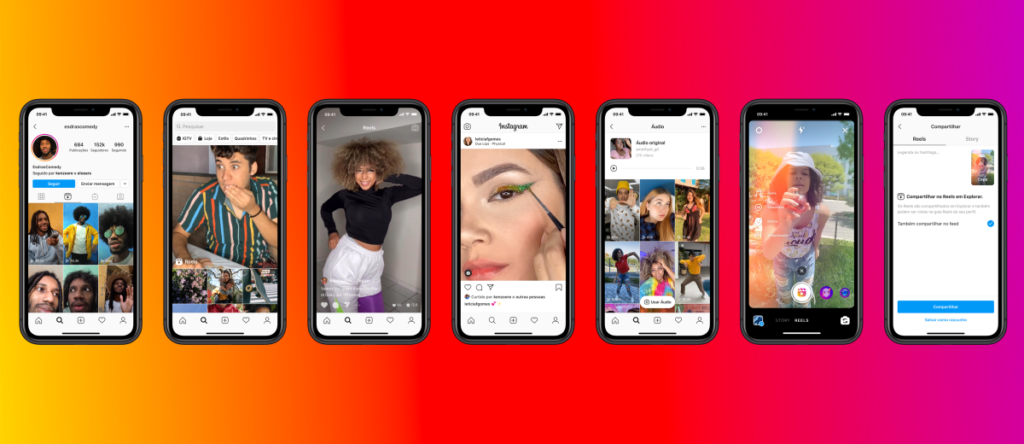
To follow through with this vision, Instagram introduced “Instagram Reels” a concept where users can watch short videos on a continuous feed much like TikTok. Reels are the newest addition to Instagram Stories and IGTV, the forms of video sharing currently on Instagram. With this change, businesses must adjust and start curating engaging videos for all social media platforms.
What the Rise of Video Media Means for Businesses
This video takeover is a turning point for many company’s branding strategies. Companies must now start using videos to highlight their products and services to promote the personality of their brand. The sole use of high-quality photography may no longer be enough. For instance, according to Social Beat, “41% of users use social media to influence their purchase decisions. Furthermore, 83% of users want to discover a brand’s personality through social media.”
Whether the videos are interactive or informative, this prominent form of media makes brands more attractive to new and current customers. Showing a company’s products and services in action allows customers to see how the products and services can help “get the job done” in their own lives.
Up Your Instagram Game
Video content has taken the world by storm and forced Instagram to adjust to a new media environment. Truly, now is the time to invest in influencers, video trends, social listening, and engagement. From creating perfect loops to setting up an aesthetic frame, Instagram’s newest video features will help many companies promote their message to target audiences worldwide.
Do you think you need a marketing audit? We’ve said it before, and we will say it a million times over – consistency in marketing equals recognition. You have to be consistent in your branding across all channels and materials. You also have to be relevant to your audience in the current marketing climate.
There is a simple solution to ensure your marketing materials are current, accurate, and consistently following your branding guidelines – an audit of your marketing materials.
What is a marketing audit?
A marketing audit is designed to make sure your materials are aligned with your goals via a review (or creation of!) your brand’s marketing plan. It is a fabulous way to keep you on pace in the marketing marathon.
It has been a hot minute. Maybe you’ve never done an audit of your marketing materials or perhaps it has been a long while since your last one. If it has been a year since your last audit, it’s time to rock one!
Demand shifts. Products and/or services routinely go in and out of style. Your offerings need to be effective based on current supply and demand fluctuations.
Products or services have changed. If you’ve added or removed products and/or services, your marketing materials need to reflect those changes.
Competitive changes. This is one area you absolutely want to make sure you’re keeping up with the Joneses. You don’t want stale messages to hold your brand back while your competitors offer fresh and inspiring marketing.
Contact information updates. If your address, phone, website or e-mail has changed, your marketing materials need to as well. If you’ve added – or need to add – a social media presence then your marketing needs to reflect that, too.
The market is constantly evolving and changing. Don’t let the materials designed to boost your brand get behind the times. A marketing materials audit gives your brand the boost it needs to keep rocking. Give us a call – we’re always ready help your brand reset and refresh.
Picture this. You have the perfect idea for an event, and you feel that it represents your brand’s vision to a T. Yet, there are so many steps to get from A to Z that you start feeling overwhelmed and as the date of the event looms nearer, you realize how many things you wish you had planned for. If you have ever felt this kind of stress before or are currently experiencing it, this is the blog for you.
When it comes to event marketing, there are multiple moving pieces. At times there are so many pieces that it may seem like there are too many starting points. To help set a starting point for you, let’s focus on the big picture and then hone into the minute details that will lead your brand’s vision to the picture-perfect moment.
The First Focus: Scheduling
Imagine event marketing to be like a photographer setting up the most picturesque scene. To capture the moment perfectly, at times working backwards is best. In this case, thinking about what you want the vision to look like as a whole then mapping out how to get to that end goal. Although this may seem unorthodox, this process will lead you to a track record of success while also allowing you to tweak the planning breakdown to fit your needs.
At Front Porch Marketing, we start with writing everything down, especially anything that is time-sensitive i.e. inviting VIPs, scheduling speakers, printing deadlines, and booking sponsors. This timeline allows you to envision a clear reality and identify immediate “strikethroughs” or ideas that should be nixed.
Next, identify your audience, define your message, and determine the experience you want to provide. Having a clear vision is important, because all of the smaller event details and decisions will flow from it.
The Second Focus: Seamlessness
Once you have the deadlines and your audience in mind, choose a venue, food, music, entertainment, format, and feel that aligns best with your vision. Stay true to the experience you want to provide, and these decisions will flow easily.
When it comes to your deadlines, also keep geography in mind. Although it may seem natural to book an event near your location, for your professional partners, sponsors, or guests this location may be new terrain. As such, ensure the professional partners and sponsors you choose to assist you are on board with your vision. Your caterer, photographer, videographer, etc. should also be well versed in what your plans and expectations are for the event.
The Final Focus: Structure
Now that your event is on the horizon, it is time to hammer out the final details. Here are some of my final tips on how to create that picture-perfect moment for your future events.
Create an overall schedule for the day and share with all of your professional partners and staff.
Double-check with your staff on their roles and make sure that all loose ends are tied.
Examples of closing loose ties:
Posting check-in times to all communication platforms.
Pre-inspecting uniforms.
Finalizing catering details with the company of your choosing and making sure no cross-contamination occurred.
Securing all entrances and marking them accordingly.
Making sure that the exits are not blocked by staff or their respected station.
Posting last minute schedule changes to all social media platforms.
Notify staff and members who should be called in case of an emergency or in the event that something needs to be addressed.
Do an event run through the night before to make sure that all equipment is running smoothly. Also do another run through at least two hours prior to the event.
Check that social media has been posted and is shareable throughout the event. (A quick way for guests to get plugged in is to post QR codes throughout the location or on deliverables.)
Center the company’s brand at the forefront of the event from color schemes to logos to swag.
Brand the sponsored content and products by making sure that they are explicitly seen.
Label Wi-Fi passwords and make them visible.
Double-check that all mandated COVID protocols are being followed. Have disposable masks and sanitation stations readily available to increase accessibility and comfort.
Promise a good time (and deliver)!
In Conclusion
We love planning, executing, and marketing events for our clients! Most recently, it has been our privilege to partner with Faith Family Academy to create a socially distanced graduation ceremony that is expandable for future success. We look forward to executing more events in the future and are proud of the recent 2021 graduates.
2021 Faith Family Academy Graduation
I hope that these tips are helpful and got your creative juices flowing! If you need help planning an event come see us on the Porch!
What is Content Marketing, and how do you win at doing it? How do you know what steps you need to take? Last month, we talked about doubling down on your brand – envisioning what your brand stands for, evolving your brand to meet your company’s needs today and emerging stronger in 2021.
This month, we’ll give you some pointers on taking your shiny new branding out into the world – with Content Marketing – for the win. What are the places that consumers will see your brand and interact with it? You’ll want to read thru to the end, because we’re going to tell you exactly what steps to take in this month’s extension of our Marketing 101.
Once your company has been thru a branding exercise, you’ll leave with your game plan and you’ll know what to do next. You’ll have your target nailed down, your brand’s personality defined and know exactly what category of business you can excel within. The first step once you’ve done this important branding work is your visual identity.
Ready, Set, Marketing – Your Brand’s New Logo
Commission an easy-to-use logo that works in many places. Your logo will be on your website, your social channels, your advertising and even on print work like business cards and brochures. Your logo should be simple, look good large or small. It should be easily used in black, white, and any brand colors you designate.
We’ve designed half a dozen new logo systems this past year, and while they are all quite unique to the company they’re designed for, they all have one thing in common – flexibility.
Your Brand’s New Website
If your company has a website, is it responsive, meaning does it work first and best on mobile but also on tablet and desktop devices? Modern websites need to be built with functionality for users top-of-mind.
This is called User Experience, or UX. How your customer goes thru their journey on your website should be carefully considered to make their experience as simple and rewarding as possible.
Next, your website should incorporate other important factors like Search Engine Optimization (SEO), which helps search engines like Google find your website easily. Google can then present it as a choice when consumers are searching for a business like yours. Using keywords and key phrases can help search engines determine how helpful your site is answering their questions.
Location is also a very highly weighted factor for search engines as well. If you are, for instance, a local restaurant trying to attract customers in the surrounding area, then this type of information should be of utmost importance when designing your new site.
Your Brand’s New Blog – the Starting Line of Your Content Marketing
Once you’ve built your website, keep your site content fresh. One of the most important parts of a new website is the blog. This is the place where the Content Marketing race starts. Regularly updating your blog means Google will keep revisiting your site to catalog the new helpful information you are sharing to “index” it for customers to find in search.
Blog posts are like a regular newspaper column for readers. They can subscribe to receive your news. They can make comments on your article at the end of the article. We write blog posts on topics relevant to our customers’ businesses for their website. This helps them to both build relationships with current customers as well as attract new potential customers.
Help solve people’s problems. Make this key in your blog content. Also, posting on a regular basis is equally important.
Your Brand’s Content Marketing Outreach
Think of your new site as your business’ virtual storefront. It’s your home base. Your social channels – like Facebook, Twitter, Instagram and LinkedIn – and other tactics like email marketing, Text Message Marketing are in essence, not just your advertising, but your chance to talk to your customers 1-on-1. An opportunity to develop a relationship with them. Each of these tactics has a specific use for a small business – every channel is not appropriate for every small business.
Winning in Email Marketing
Content marketing’s main ingredient is email. First, email marketing shares insider information with your best customers. After all, they opted in to receive this email newsletter from you. For instance, retail stores could offer special discounts, special not-on-the-website items, and special gifts-with-purchase to their favorite customers – which in the digital world would be their email subscribers.
For a restaurant, email marketing can announce a dining event, or a big menu change. Or a business service could announce open jobs, industry news that would affect their customers or tips and tricks to get the most out of their service.
Winning in Social Media
Social media, as a content marketing winning tactic, promotes blog posts, events, promotions, products or simply build conversation and relationships with different customers.
Our restaurant example, for instance, would want to rely heavily on Facebook, as that is the place to grow a local community – interacting with actual people who rely on their business, garnering reviews from customers, and posting events that their businesses is hosting.
But, an interior designer however, would focus on Instagram, as their clients might be all over the country, and consumers on Instagram are interested in all things beautiful. Hashtags #likethisone at the end of an Instagram post help customers find your business, much like the old card catalog at the library could help you find books on a specific topic.
Use Twitter for getting and sharing news with industry peers to establish your voice of authority. Are you an expert real estate broker? Then, share industry news in your category and give your take on any particular article. Follow reporters who work on your segment of business and interact with them when appropriate to demonstrate your expertise, making you a viable option for quotes in articles in the future.
Further, on LinkedIn, a non-profit foundation could share their quarterly goals, fundraising efforts and events, and results to a business audience of potential donors and board members.
Your Brand’s Content Marketing Win
Start with your brand. Establish a strategy for your content marketing for the win. Implement your tactics. Understand that marketing, and especially digital marketing, is a marathon with no finish line. How you run that marathon matters. Keep at it, perfecting the steps you take a little at a time. But start by taking that first step in content marketing for the win.