Author Archives: Julie Porter

A winning marketing campaign is all about selecting choice plays from your marketing playbook to best reach a specific goal. It is a single piece of your overall marketing plan, not the whole playbook. You wouldn’t run all of your plays against every opposing team. Marketing campaigns are tailored to individual need(s), too.

Why do you need one?

Any brand looking to launch a new product or site, announce an expansion, celebrate a milestone or grow interest in a specific event can benefit from a marketing campaign.

One of our clients is a well-known and respected local healthcare facility. They needed to market an expansion project three years in the making. Children and their families are their focus, so they requested a game or an app. They wanted to reach more than just their internal audiences (patients and families) though. To reach external audiences (the community at large, donors, etc.), they really needed more than a single marketing tool. They needed a full court press campaign.

How do you create a winning campaign? Here are 5 key components to success:

  1. Determine your why. What is your goal? Is it a successful event, increased sales numbers, greater foot or website traffic, or making your brand more recognizable? Once you know the endgame, you can start figuring out how to play it to win it.
  2. Scout the roster. Who is your target audience? What are their likes, dislikes, and the mediums they are most responsive to? If you don’t know who is playing the game, you’re going in behind in the count.
  3. Choose the right venue. Oftentimes when you think of marketing campaigns billboards, mailers or TV ads come to mind. It can be any (or all) of those, but it can also be so much more. Perhaps social media or e-mail marketing is a better choice. A combination of things may score the most points. It is all about appealing to your audience in the arena(s) they know best. Marketing campaigns are not one-stop shops.
  4. Timing matters. If you are launching a product, you want to play the long game to develop interest beforehand and keep it rolling long after. This was the case for our client. They needed a three-year campaign to match their three-year expansion project. If you have a major event scheduled, then you have a “big game” situation. Hyping it up beforehand and making sure to have the right crowd in attendance means you have to watch the clock.
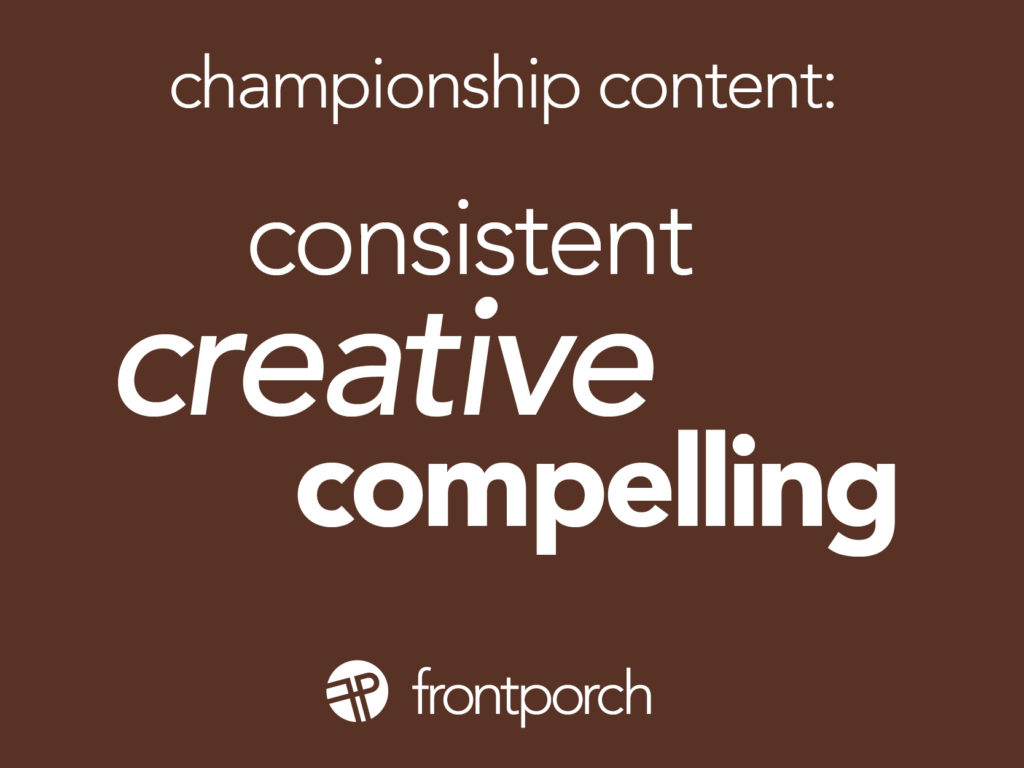
  5. Create championship content. Remember the Rule of 7 and make sure your content is consistent, creative and compelling.

A winning marketing campaigns is all about learning what makes your crowd go wild. We’d love to join your team and help you plan for the dub.


Your brand has a voice.

As your brand’s marketer, you have control over whether that voice builds your brand or not. A strong brand voice is the structure and tone of the copy and content that is created for a brand to speak from. You can hear this voice on its website, ads, social and in collateral. With consistency, a brand can feel like a person. And over time that person can become familiar and even recognizable. That’s when you know you’re doing it right.

Why does brand voice matter?

First, a part of your initial branding exercise, your brand might have completed something similar to what we call The Brand Elaborative. This branding document outlines the personality of the brand. This helps writers write in that voice when creating copy for digital and traditional marketing and advertising. One of the most important parts of The Brand Elaborative are the three personality words that describe the brand as if it were a person. For instance: honest, kind, quirky. So why does having a distinctive brand voice matter to your brand?

Brand voice drives consistency.

Our B2B client Agile Sourcing Partners specializes in helping gas and electric utilities and utility infrastructure companies improve operational efficiencies and performance. So, they speak in an authoritative voice with above average complexity of language. Given that their audience are decision-makers in engineering and other technical industries, it makes sense for them to speak the language of their peers. Thus, using this consistent voice in content sets them apart as insiders: educated and in-the-know.

Brand voice helps you discern what copy hits the mark – and what misses.

Our restaurant client Chocolate Angel Café & Bakery is a local favorite for cross-generational high teas, exquisite baked good and charming family recipes. They believe in serving one another and understand that relationships matter. Thus, their brand voice is connective, celebratory and conjures up memories of childhood. They express gratitude often, and make every day feel like a special occasion. So it’s no wonder they’re a favorite for bridal showers and family celebrations. If it sounds like your great aunt reminiscing about a casserole, then we’ve hit the mark.

Brand voice creates fans.

Our education client Faith Family Academy, a charter school in DFW believes in pushing public education beyond just the classroom. They speak in servant leader’s voice. FFA makes students the center of attention, celebrating wins and putting every effort possible into their individual and collective success. The social media channels for Faith Family Academy are a testament to this brand voice in creating fans. In both English and Spanish their fans celebrate right along with the students, staff and parents. The FFA community adds congratulatory comments and a plethora of emojis on a daily basis. So who wouldn’t want to be part of this kind of enthusiasm, joy and experience of being lifted up by your community?

Brand voice can make your brand the authority on subject matter.

Our real estate client The Slay Diaz Group is a woman-owned residential real estate team who regularly wins “best-in-class” awards for their work. As a result, their voice is very real, straightforward, easy-to-understand and ready to give helpful advice on everything home-related, even sharing their coveted list of service providers. This is who you ask when you don’t know if remodeling your bathroom is a good idea or not. And, this is who can tell you if now is a good time to sell your house, put in a pool or move to a new neighborhood. Their consistent brand voice has grown their business, their reach and their authority on the subject of residential real estate.

Some of the brand voices from Front Porch Marketing.

Brand voice lets people know what you stand for.

Our own brand voice here at Front Porch Marketing tells you that we will go the extra mile to help. That we share what we know without reservation. And that we will be your biggest cheerleader. We stand for lifting you up, making you laugh and creating opportunities for others to do the work they love while taking care of the people they love. If your brand has a mission, shouldn’t all of your content reflect that mission? We think that your brand voice can show your potential customers that you are like them – kind, helpful, positive – and they will want to hang around with people like that.

Need to define or redefine your brand voice for better consistency and stronger connections with your audience? Then get started with a branding exercise which results in the guidance documents you need to hone your tone and define your voice. Consumers actually prefer brands with strong, defined and unique personalities. And having a unique personality definitely helps in creating spot-on social content, email storytelling and website visuals for your brand – which results in stronger brand loyalty and repeat customers.

You can visit some of our Front Porch client brands to see different types of brand voice in action.


Marketing meeting must-haves. What are they?

If you’ve ever sat through a meeting and walked out wondering what its purpose was or why you were there, then you know you don’t ever want to be the host of such an event. The must-haves must have been missing. Must-haves are important, and this is especially true in marketing where people expect you to get their creative juices flowing from the start of the meeting. To help you avoid being a bad host, here are eight must-haves for hosting your next marketing meeting – and making it successful.

Meet only when necessary.

If something can be easily covered via e-mail, it should be. 

A prepared – and shared! – agenda is the best start.

An advance agenda helps set the tone of the meeting, lay out the goals, and allows people to budget their time, as well as prepare responses. Be sure to include time for brainstorming!

Begin with the end in mind.

Know what you are trying to accomplish during your meeting. This is not a status conference. The goals need to be clearly defined so that they can be addressed and accomplished.

Keep meetings small.

The smaller the group, the better the collaboration. Amazon’stwo-pizza team rule for productive meetings is well-known and highly successful. The idea is that the group must be small enough that two pizzas can feed all attendees. This keeps ideas from being drowned out by too many voices.

Keep your marketing meeting short.

Be respectful of people’s time. No more than an hour – half an hour is even better.

Keep it simple.

Use pictures. Charts. Demonstrations. Content is king in marketing meetings too so make them compelling and focused, but not overwhelming.

Keep distractions out.

Set a no-computer rule and declare phones emergency-only devices.

Keep it interesting.

You don’t want a boring, tedious marketing meeting.  For instance, kick off the meeting in a fun way to grab their attention.

At a kick-off marketing meeting, for a client in the concrete industry, we needed to explain to the team that their audience didn’t know the difference between cement and concrete. How did we capture their attention? Cake batter. We demonstrated the difference in simple, relatable terms – without using engineer-speak.

Cement was represented as a box of cake batter. Concrete was then explained as the combination of the box of batter plus all other ingredients – resulting in a cake. This simple demonstration of making a cake in the meeting got the team’s attention, engaged their imaginations and helped them understand how their audience thought of them. Plus, CAKE!

Marketing Meeting Must-Haves are a Must

Well-organized marketing meetings can be great for productivity, team building, and brand development. Keep these marketing meeting must-have tips in mind so all you have to worry about is getting those creative juices flowing to rock your next marketing meeting.


Do you think you need a marketing audit? We’ve said it before, and we will say it a million times over – consistency in marketing equals recognition. You have to be consistent in your branding across all channels and materials. You also have to be relevant to your audience in the current marketing climate. 

There is a simple solution to ensure your marketing materials are current, accurate, and consistently following your branding guidelines – an audit of your marketing materials.

What is a marketing audit?

A marketing audit is designed to make sure your materials are aligned with your goals via a review (or creation of!) your brand’s marketing plan. It is a fabulous way to keep you on pace in the marketing marathon.

Here are five reasons you may need a marketing audit:

  1. It has been a hot minute. Maybe you’ve never done an audit of your marketing materials or perhaps it has been a long while since your last one. If it has been a year since your last audit, it’s time to rock one!
  2. Demand shifts. Products and/or services routinely go in and out of style. Your offerings need to be effective based on current supply and demand fluctuations.
  3. Products or services have changed. If you’ve added or removed products and/or services, your marketing materials need to reflect those changes.
  4. Competitive changes. This is one area you absolutely want to make sure you’re keeping up with the Joneses. You don’t want stale messages to hold your brand back while your competitors offer fresh and inspiring marketing.
  5. Contact information updates. If your address, phone, website or e-mail has changed, your marketing materials need to as well. If you’ve added – or need to add – a social media presence then your marketing needs to reflect that, too.

The market is constantly evolving and changing. Don’t let the materials designed to boost your brand get behind the times. A marketing materials audit gives your brand the boost it needs to keep rocking. Give us a call – we’re always ready help your brand reset and refresh.


Business growth is always top of mind for me. Bringing it to the forefront is the fact that I am 2/3’s of the way through my Goldman Sachs 10,000 Small Businesses Back to the Classroom program. Back to the Classroom is an opportunity for 10KSB alumni to reconnect with the lessons and concepts of the 10KSB program as we navigate the current economic situation and our next business opportunity.

Each week of the four part series addresses the key learnings from program modules. For each session, we are required to attend webinars and growth group meetings.

In between sessions, we have homework. We continue to refine our new business opportunity.

And, unlike my last 10KSB experience, this one is national. Every section of 10KSB Back to the Classroom includes alumni from across the country. I engage with small business owners from Alabama, Maryland, Missouri, New York, North Carolina, Ohio and Oklahoma every few weeks. This is probs my favorite part.

Key Takeaways Thus Far From Back to the Classroom

  1. Networking, even virtual, is a good. Even though this group might not be my buyers, they are inspiration. They know people who may be buyers.
  2. Brainstorming with other small business owners who work in other industries is priceless. This group is energized and excited to help each other. The ideas shared and problems solved big and small help refine and shed new light to the strategy and execution.
  3. Run the numbers. Work the scenarios. It is painful, like stick a needle in my eye, torture for me. However, with help from my business advisor, the time spent doing this was invaluable. The financial exercises are proof of my concept. The numbers less daunting than I expected.
  4. Keep reading. Even if you don’t have the time, make time. I have four new books on my desk suggested by this group. Three I have never heard of.

Lastly, don’t undervalue the power of collaboration. I collaborate with my team on the daily. And, for that, I am blessed. But, collaborating with this group reminds me how valuable that is.

For business growth, you need lifelong learning. You need motivation. Small business owners are equally interested in positive outcomes for other small business owners. Keep calm and collaborate on.


2021 moved consumer shopping from brick and mortar to eCommerce – most likely for good. Increased demand for online shopping turned retail into an Omnichannel experience over night. Right at the cusp of experiential retail taking over, many retailers pivoted to eCommerce. So online was the only experience in shopping last year for many. Some stores and services even stayed exclusively eCommerce for the better part of 2021 – and remain so still.

Moving a brick and mortar business to eCommerce – like a restaurant, a doctor’s office, a clothing boutique – isn’t easy, and in 2020 many retailers moved their businesses years into the future in an instant. How exactly did they do that?

Pivoting from bricks to clicks

While planning to add the services of tele-health such as video sessions and text therapy, our client Apple Counseling sped up their timeline when 2021 presented them with a situation where their services were more in demand than ever. Yet, in-person brick and mortar was not the preferred method for experiencing mental health services.

By putting the infrastructure in place to accommodate many types of digital health services, and a robust new website, Apple was able to pivot quickly from exclusively brick and mortar to ecommerce. Going forward, they’ll keep the digital services they’ve added as they open their offices back up to in-person sessions. This new hybrid model is one that is being replicated all over the world of retail.

How to incorporate brick and mortar to ecommerce into your business model

Making ecommerce part of your long-term strategy is a smart move. eMarketer estimates that ecommerce sales grew 27.6% in 2020. Start by assessing how your customers use your business. For instance, if you are a restaurant, what percentage of your business is already take-away and to-go orders? What are you doing to maximize this experience for your customers already, and how can you streamline it or plus it up to make it better? Increase your eCommerce sales by adding new ways to order like website, social, text or 3rd party apps.

A consumer Incisiv survey  indicated that 80% of shoppers expect to continue to use contactless and curbside pickup this year. Can you repurpose part of your brick and mortar space to make it easier to fulfill your eCommerce orders? Instead of a clothing boutique, can you make your merchandise accessible on-line?

Our client GNB, a women’s clothing retailer, quickly built out website and Instagram last year to showcase her customer’s favorite brands and fulfilled orders in a new way. Now that she has opened her brick and mortar up in a new space, she is keeping the online store in place to continue to cater to the wider audience she developed when she was exclusively online.

Your Business Strategy Pivot

When you move from in-store to on-line you’ll need to perhaps rethink your business plan to accommodate a regional versus local audience. Rely on your social media analytics for demographic information to guide your choices. Cater to the right audience. Think about the yoga studios that pivoted to teaching class online, or the wineries that now offer Zoom tastings with professional sommeliers.

Your “physical” space might become an order fulfillment center, or a showroom only. Showrooms are a growing choice for retailers (like Sephora) to show off a smaller portion of their total inventory. Customers can then place their orders in the showroom. Or, return to pick them up in a few days or have them sent to their home. But the customer will have had the chance to interact with your retail brand in person to some extent.

Your New Brick and Mortar to eCommerce Product Mix

Products that factor into an eCommerce retail business versus an in-person retail business may vary. Consider shipping, logistics and storage when rethinking your product or service mix. Think about what consumers are looking for – the needs of the market. How your brand can make your customers’ lives easier in some way?

Marketing for a digital-first business

With an eCommerce-first model, more of your budget will go to digital improvements in your website, digital marketing and social media. Upgrade not just the look of your website to really give customers the feel of your brand – upgrade your SEO. Search engine optimization can help the right customers find you on search engines. Use a combination of keywords, content marketing, targeted digital marketing and social media. Optimizing how you talk about your business online can help new customers find you faster.

When your brand transitions from brick and mortar retail to eCommerce, you can reinforce your brand’s benefits with your current customers while growing a new audience online. Then the convenience of online retail opens up a whole new world of potential business. With some thoughtful strategy and a digital marketing plan, your retail business can capitalize on this trend, and you can double down on your brand smoothly and successfully moving from brick and mortar to eCommerce.


Chances are you have seen a post or two about what days and what times are the best for posting on social media. And in fact, they are all probably right, and probably wrong. You see, the best time and place for YOUR social media is totally dependent upon your followers.

Short Cuts to an Optimal Social Media Time and Place Posting Schedule

What people want is a quick fix to their social media. A set-it-and-forget it system that they can follow that requires the least amount of work. But social media is not a broadcast channel like television, radio, or a print ad. Social media is supposed to be SOCIAL. Your social media channels are the place where you can actually have one-on-one conversations with people who love your brand already. How do you know they love you already? They’ve chosen to follow you, haven’t they? So talk with them when they are sitting there ready to have that conversation.

Sure, there are general guidelines for posting on social media channels, many of which have to do with putting yourself in someone else’s shoes for a moment. When are people most likely scrolling thru Instagram? What are people doing on their lunch break besides eating? (hint: scrolling thru Instagram) What’s the last thing that people do before they go to sleep at night, while they’re laying in bed? (another hint: scrolling thru Instagram) You get the picture. So how do you determine what social media channels and times are the best for your brand? When can you maximize a conversation with your followers going forward? The short answer is “the past”.

The Right Channel for Your Social Media

Each social media platform has a specific and different purpose. By offering a little bit different perspective and content on each channel of social media (instead of using the channels to broadcast like a tv or radio station) a company can show their many sides and offer a more nuanced look at their company, much like you would develop a friendship with a real person and grow to appreciate the many facets of their personality. So after you’ve given your social media channels a spring cleaning, start looking at your analytics.

Social Media Analytics

Every platform you post on for your brand has some form of analytics. You can see a surprising amount of information about your followers in the insights part of your dashboard, whatever the platform. One of the most valuable pieces of information in there is when your followers are on the platform. Start there. Your followers might be the breakfast crowd, in which case 6:15 – 8:30am is a good time for you. Maybe your followers are night owls in which case, program your posts (or manually post them) after 9:00pm.

With 63% of American users checking Instagram at least once a day, and 74% of American users checking Facebook once a day – according to Hootsuite – , you’re sure to find at least one and probably more than one heavy use time in your follower insights.

Scheduling platforms like Hootsuite, Buffer and Planoly make it even easier – they look at the analytics of your followers and tell you the best times to post without the research. Taking advantage of these low-cost automation platforms can save you valuable time, so you can concentrate your efforts on content creation.

Past Performance

Look at your social media feed on any channel as an indicator of what to post in the future. Which posts did well? What type of content got the most likes or comments? Do more of that. Look to your past performance to guide your future endeavors.

What are your competitors doing?

Competitive research is not just for branding and creative. Take a look at what your competitors are posting – what, when and where – when you’re setting up your optimal schedule. Look for patterns in not just your own feed, but in the similar feeds of your competitors and do more of what they are doing the best.

Post, Rinse, Repeat

Testing your content in different forms and at different times will also provide key insights when scheduling the best times and places for your social media as part of your content marketing plan. There is no one-size-fits-all best time solution that will fit every grand, as your brand’s best time and best platform are just as unique as your branding.

With a little effort upfront, you can glean insights into your audience that will not only increase your engagement, but actually help your followers even more. They have questions they want answered and you have the answer – so use the information that is readily available and answer that question sooner.


Remote work happens and has before 2020. Newsflash!

The pandemic made it essential. Corporate offices closed. ODL. Now what are we going to do?

Many were unsettled.

Front Porch Marketing didn’t miss a beat.

Going back to 2011 when our company was founded, I was inspired by a business leader who started her business on a virtual model years prior. They still are rocking remote work and a “galactic headquarters.” F yer I. Successful companies have been using this model for years and years.

Companies functioned virtually decades before 2020. Really? Yes, friends, yes, they did.

Many questions were asked in 2020:
Team engagement. How can we function as a team without our myriad of useless meetings?
New business development. How would I do new biz development if not meeting one-on-one? Talk to your business partners. Existing clients, associations, affiliations, time to find new connections via LinkedIn.
Meetings. We must be in person and spend an hour at least pontificating all the thing. Nope. No, you do not.
Client relationships. How can we nurture them if they aren’t in person? Pick up the phone.

5 key reasons, and there are more, remote work works

  • It is more efficient. Less time spent commuting, more working.
  • Remote work is flexible. Choose the hours you work. Throw in a load of laundry between emails. It is important to remember, however, you don’t always have to be “on.” Walk away from the computer light, Carol Ann.
  • Enhances the work horizon. Our team is all over North Texas and Colorado and and and which means we can benefit from being a part of many communities and have access to top talent anywhere.
  • Business development happens. Less disruptions, more focus. Biz dev doesn’t have to be face to face. Utilize your resources. Resourceful people find new ways to make shit happen so their businesses thrive.
  • Saves money. Eliminates the unnecessary things. I pay my mortgage only, not rent for an office and its utilities too. Only one cleaning service. Less tax burden.

How we work impacts everything from our satisfaction to the broader economy. Speaking of broader economy, we are seeing wide reaching benefits from the pandemic. More small business owners are open to working with agencies that aren’t in their own backyards.

I will save the story of the business referral someone gave to a rocking business owner in California that recently led to our newest client relationship.

We aren’t “remaking work.” Remote work is how we have worked for 10 years. We focus on doing great work with people we love for people we love while taking care of our loves.


We have put together a must-read list of ’10 marketing books for 10 years’. Front Porch Marketing turns 10-years-old this month! Marketing has been constantly evolving over the past decade. As an all-remote, agile marketing company, we’ve evolved right along with it. But sometimes it can get hard to stay on top of all the changes.

That’s why we turn time and time again to the experts in our marketing books. In honor of our 10th anniversary, we rounded up 10 must-read marketing books that we think demonstrate positive perspectives and practical advice.

Books are one of the easiest ways we know to dive into new marketing topics. Then we can grow our practice and application of that knowledge. We hope these suggestions offer you some inspiring new perspectives on the ever-evolving world of marketing and help you stay on top of all the changes. If we can help you with your marketing challenges in any way, please ask!

Must Reads: 10 Marketing Books for 10 Years – our marketing reading list for 2021

Permission Marketing: Turning Strangers into Friends and Friends into Customers by Seth Godin

This is one of our favorites. Seth teaches you how to frame your marketing messages so that your customers will willingly accept them. Permission marketing enables brands to cultivate long-term relationships with customers. This builds trust and ultimately increases the likelihood of making a sale. Seth challenges you to only talk to people who are already raising their hand asking to speak with you. Then he shows how this customer is your most valuable one.

Give and Take: Why Helping Others Drives Our Success by Adam Grant

This one is near and dear to our own Front Porch Marketing mantra. Adam – an award-winning researcher and professor – says that the key to success is not ambition or greed, but thoughtfulness. Good guys will indeed finish first in Adam’s worldview. And he gives ample evidence and example to prove it.

The Results Obsession: ROI-Focused Digital Strategies to Transform Your Marketing, by Karen J Marchetti

Karen leads with proven and practical digital strategies to boost client leads. She shows you how to increase email click-through rates and generate higher opt-in rates. She shares how to assess your current digital marketing channels like SEO, email and PPC and optimize them for better results. And with an emphasis on small business, this book serves as a handbook to make the most of every marketing dollar.

Marketers of Tomorrow: A Step by Step Toolkit for Inbound Marketing by Tyrona Heath

Tyrona, a Google marketing alum, offers valuable information on attracting and converting customers using inbound marketing. With SEO, blogging, social media and email marketing as your toolkit, follow Tyrona’s step-by-step system to set up and deliver an inbound marketing plan. Turn strangers into visitors, visitors into leads, leads into customers and customers into loyalists using minimal resources.

Blue Ocean Strategy: How to Create Uncontested Market Space and Make Competition Irrelevant by W. Chan Kim and Renee Mauborgne

The authors of this book base their thinking on a study of 150 strategic marketing moves spanning more than 100 years and 30 industries. They show you how to build lasting success from creating a new market space (a blue ocean) in which there are no competitors. This book represents a ground-breaking new perspective because dominant marketing thinking for the past 25 years has been concerned with creating revenue by taking market share away from a competitor.

Brand Storytelling: Put Customers at the Heart of Your Brand Story, by Miri Rodriguez

Miri helps brands understand the why and how of infusing their marketing strategies and tactics with an authentic voice that will resonate with consumers. This book serves as a template for helping brands discover that voice, and their story, and structuring them to share insights with their customers.

Killing Marketing: How Innovative Businesses are Turning Marketing Cost Into Profit by Joe Pulizzi & Robert Rose

Joe and Robert – the founder and the Chief Strategy Advisor for the Content Marketing Institute – share bold thinking putting content at the forefront of marketing. They’ll help you create value for consumers and instill loyalty in your followers. This book outlines how to look at marketing as a profit center instead of a cost center. Content marketing helps brands own media instead of purchasing it.

The Hidden Psychology of Social Networks: How Brands Create Authentic Engagement by Understanding What Motivates Us, by Joe Federer

Joe, the former head of strategy at social media giant Reddit, offers effective engagement strategies on social media through the lens of human psychology, neuroanatomy, biology and anthropology. Using more than a decade of experience, he explains consumer behavior in social media in terms of how the different social platforms each represent different mindsets: the Id, the Ego, and the Superego.

Tap: Unlocking the Mobile Economy by Anindya Ghose

From the MIT Press, Anindya draws from his extensive research in the US, Europe and Asia using real-world examples from global companies to explain consumer behavior in the mobile realm. He identifies nine forces that shape consumer behavior and how to tap into those forces to influence shoppers and maximize brand opportunities.

What’s Your Problem? Become a Better B2B Marketer by Enhancing Your Problem-Solving Skills by Steve Goldhaber

Before jumping into content marketing, step back and assess what the core business problems are that content marketing can solve. Steve offers a guide to identify and define those problems. Then he helps you understand where content marketing can add the most value for your brand. Content marketing is more than just writing and design, and Steve teaches better techniques for distribution, measurement and optimization.

Let us know if you’ve read some of these, or have others that are your favorites! Please share your favorite marketing books in the comments to make our list more complete.


Empathy. Understand and share the feelings of another. More relevant in our country now more than ever.

Like many, last week on the Porch was spent defrosting from the massive winter storm.

Natural disasters occur. Business owners and leaders lead with empathy.

Heed these marketing and communication 101s:

  • Safety first. Focus on the wellbeing of your team, then your clients. Reach out to check on them, their families and business. Focus only on their immediate needs and any help you may be able to offer. Show genuine empathy for those in crisis. Everything else waits.
  • Teamwork makes the dream work. Thanks to one of our amazing team members, we had two co-working spaces. We were able to use that to communicate with our clients and to help them manage their internal and external business messages. In turn, it was easier for our clients to focus on their own team’s needs. Rally the troops that are available and get to work focusing on others’ needs.
  • In addition, dedicate to serving who, how and where you can. We know from our own experience that the smallest gesture can make a powerful impact. This time, the Porch had power so we were able to offer our space and internet, and laundry room, to our Clients and friends who did not. Other clients had water their neighbors did not and eagerly gave of their own resources. Others may simply need an ear to listen. Make it a point to let your clients know you are there to help them in any way you can, not only with the needs that earn you income.
  • After that, patience is a virtue. Rethink planned marketing initiatives.
    • Email marketing: Your communication can wait when other people are in crisis.
    • Social media posts: Meet your customer or Client where they are. During these times, emotions are highly-charged. Be authentic and empathetic.
    • Press releases: Don’t send press releases during times when a portion of the country is going through damaging events. Timing is everything.

Most importantly, extend empathy. There will come a time when you are facing your own unexpected storm and will need someone else to freely offer it to you.

In conclusion, we hope you and yours are safe, warm and damage-free. Client service is not simply our job; it is our heart.

Please reach out if we can help you.