Tag Archives: Business Leaders

In the evolving landscape of B2B marketing, staying ahead of emerging trends and predicting shifts is crucial for the future of B2B marketing. Small businesses need to aim to carve out their niche and thrive in competitive markets. It’s essential for small B2B enterprises to anticipate and adapt to evolving consumer behaviors, technological advancements, and industry dynamics.

What is the future of B2B marketing? Find out by exploring key trends and predictions that small businesses should consider as they chart their course for success.

Rise of AI and Automation in the Future of B2B Marketing

First, Artificial intelligence (AI) and automation are poised to revolutionize the future of B2B marketing strategies. They offer unprecedented capabilities for personalized targeting, predictive analytics, and workflow optimization. Small businesses can harness AI-powered tools to streamline marketing processes, enhance customer segmentation, and deliver hyper-targeted messaging across multiple channels. By leveraging AI and automation, small B2B enterprises can increase efficiency, improve ROI, and gain a competitive edge in the digital marketplace.

Embrace of Account-Based Marketing (ABM)

Next, Account-Based Marketing (ABM) continues to gain traction as a strategic approach for B2B businesses. ABM can target high-value accounts and personalize marketing efforts to meet their specific needs. Small businesses can adopt ABM strategies to nurture relationships with key accounts. And deliver customized content, and drive engagement at every stage of the buyer’s journey. By focusing resources on the most promising prospects, small B2B enterprises can maximize the future of B2B marketing ROI. Ultimately they can accelerate sales growth in a targeted and efficient manner.

Shift Towards Interactive and Immersive Content

In an era of information overload, capturing and retaining audience attention requires innovative content experiences that engage and delight. So small businesses can differentiate themselves by embracing interactive and immersive content. Formats such as augmented reality (AR), virtual reality (VR), and interactive video are key. By creating immersive storytelling experiences, small B2B enterprises can captivate audiences. Additionally, they can foster brand loyalty, and drive meaningful interactions that resonate with their target audience.

Integration of Sustainability and the Purpose-Driven Future of B2B Marketing

Consumers are increasingly seeking out brands that align with their values and demonstrate a commitment to sustainability and social responsibility. Small businesses can differentiate themselves by integrating sustainability and purpose-driven messaging into the future of B2B marketing strategies. By highlighting their environmental initiatives, community involvement, and ethical business practices, small B2B enterprises can build trust, loyalty, and goodwill among their audience while making a positive impact on society.

Personalization at Scale

Finally, as consumers expect more personalized experiences from brands, small businesses must leverage data-driven insights. They need to use advanced segmentation techniques to deliver tailored messaging at scale. By harnessing customer data and predictive analytics, small B2B enterprises can create highly personalized marketing campaigns. These resonate with individual prospects and drive conversion. From personalized email campaigns to dynamic website content, personalization allows small businesses to connect with their audience on a deeper level and nurture long-term relationships.

Embracing the Future of B2B Marketing

As the future of B2B marketing landscape continues to evolve, small businesses must embrace innovation, adaptability, and forward-thinking strategies to stay ahead of the curve. By anticipating trends such as the rise of AI and automation, the embrace of ABM, the shift towards interactive content, the integration of sustainability, and the importance of personalization, small B2B enterprises can position themselves for success in an increasingly competitive marketplace.

Overall, as you navigate the complexities of B2B marketing, remember to stay agile, experiment with new technologies, and prioritize delivering value to your audience. Then by embracing the future of B2B marketing, small businesses can seize new opportunities, drive growth, and thrive in the digital age.


In the dynamic world of business-to-business interactions, forging strong B2B partnerships is essential for long-term success and growth. These strategic alliances not only expand market reach but also foster innovation and mutual support. However, building strong B2B partnerships requires careful planning, effective communication, and a commitment to shared goals. Here are some key strategies that businesses can implement to cultivate meaningful and enduring partnerships in the B2B landscape.

Establish Clear Objectives and Alignment in B2B Partnerships

At the core of any successful partnership lies a shared understanding of objectives and alignment of goals. Before embarking on a collaboration, take the time to define what success looks like for both parties. Clarify mutual expectations, identify common challenges, and outline how each partner can contribute to achieving shared objectives. For example, a technology company seeking to enhance its cybersecurity offerings may form a strategic alliance with a cybersecurity firm to jointly develop integrated solutions that address both data analysis and security concerns.

Foster Open and Transparent Communication

Effective communication is the cornerstone of any successful relationship, and B2B partnerships are no exception. Cultivate an environment of open dialogue and transparency, where both parties feel comfortable expressing their needs, concerns, and ideas. Regular check-ins, status updates, and feedback sessions help ensure that everyone remains on the same page throughout the partnership journey. For instance, a manufacturing company building strong relationships with suppliers ensures a steady supply of raw materials or components, fostering reliability and efficiency in the production process.

Prioritize Mutual Benefit and Value Creation for B2B Partnerships

Successful B2B partnerships are ones where both parties derive tangible value from the collaboration. Focus on identifying areas of mutual benefit and value creation, where each partner can leverage their strengths to achieve shared goals. Whether it’s access to new markets, innovative technologies, or complementary expertise, seek opportunities to create win-win scenarios that drive mutual growth and success. For example, a software company may partner with a network of resellers to distribute its products to different geographic regions or industries, expanding its market reach while providing the resellers with a lucrative revenue stream.

Invest in Relationship-Building and Trust

Building strong partnerships takes time and effort, and investing in relationship-building is essential for long-term success. Take the time to get to know your partner’s business, culture, and values, and foster personal connections with key stakeholders. Building trust is paramount, so be reliable, transparent, and honest in your interactions. Demonstrate a commitment to the partnership by following through on promises, addressing concerns promptly, and actively seeking ways to add value to your partner’s business. For instance, marketing and co-marketing partnerships allow businesses to collaborate on initiatives that amplify both parties’ reach and visibility, such as co-creating content or launching co-branded campaigns.

Embrace Collaboration and Adaptability in Your B2B Partnerships

Flexibility and adaptability are essential qualities for successful B2B partnerships. Embrace a spirit of collaboration and be open to exploring new ideas, strategies, and opportunities together. Remain agile in responding to changing market dynamics, evolving customer needs, and emerging industry trends. By fostering a culture of innovation and continuous improvement, you position your partnership for long-term relevance and resilience in the face of uncertainty. For example, companies often form partnerships to enhance their product offerings or expand into new markets, leveraging each other’s expertise to develop innovative solutions that address evolving customer demands.

Leverage Expertise Through Strategic Partnerships

Leveraging expertise through strategic partnerships can provide B2B companies with specialized skills and knowledge to enhance their offerings and market presence. Collaborating with a marketing firm, for example, can offer significant benefits for businesses looking to elevate their brand visibility, generate leads, and drive revenue growth. A B2B partnership with a marketing firm can provide access to a range of marketing services, including strategic planning, digital marketing, content creation, and campaign management. By tapping into the expertise of marketing professionals, B2B companies can develop tailored marketing strategies and tactics that resonate with their target audience and align with their business objectives.

For instance, a professional services company seeking to expand its market reach may partner with a marketing firm specializing in B2B lead generation and digital marketing. Through this partnership, the services company gains access to a team of marketing experts who can develop targeted campaigns, optimize online presence including SEO, and leverage data analytics to identify and nurture leads effectively. By outsourcing marketing efforts to a trusted partner, the services company can focus on core business operations while benefiting from the marketing firm’s industry knowledge, resources, and experience.

Cultivating Strong B2B Partnerships is a Win-Win

In the interconnected world of B2B commerce, building strong B2B partnerships is not just advantageous — it’s imperative for sustainable growth and competitiveness. By following these strategies and incorporating examples of specific partnership types, including collaborations with marketing firms, businesses can cultivate meaningful and enduring partnerships that drive mutual success. As you navigate the intricacies of B2B relationships, remember that the strength of your partnerships lies in your ability to collaborate, communicate, and innovate together.


This is anniversary number 13 and it is sweet and humbling. And I am forever grateful for our team, clients and advocates.

13 is a lucky number.

It represents fearlessness. And, although at times fearlessness is hard amidst all that is going on with our business, clients, family, and in the world, for our business and me it is a guidepost.

Today I’m sharing 13 branding and marketing truths that still ring true, to celebrate our 13th year of doing what we love.

  1. Branding – Start-ups and small to midsize businesses who have defined and live their brand architecture achieve their business goals.
  2. Conviction – Successful businesses and business leaders articulate their brand. They know it stands for a specific and meaningful promise. These business leaders champion it internally as well.
  3. Consistency – Our clients deliver on their brand at every point of contact, internally and externally. They understand if they don’t it will dilute the competency of the organization.
  4. Connection – The relevancy and persuasiveness of a brand must be realized by the business’ target. Emotional connections make target audiences more predisposed to your company and its products or services.
  5. Knowing you are not your customer.
  6. Yet, knowing who your key client or customer targets are key.
  7. Defining and monitoring the competitive landscape.
  8. Creating and integrating key messages into all communications.
  9. Being grateful for your relationships. Give back to those who support you. Encouraging them and providing help to them professionally or their businesses along the way.
  10. Networking – This doesn’t have to be large groups, weekly or monthly meetings. But those help. Always be open to meeting new people and trying to help or connect with them.
  11. Email marketing is the bomb. Don’t underestimate its power.
  12. Having and trusting strong account managers, creative directors and content specialists. They make magic happen.
  13. Work with people who you love, for those you love, creating and executing work you love, whilst taking care of your loves.

Trade shows and conferences offer invaluable opportunities for B2B businesses to network, showcase their offerings, and stay ahead of industry trends. However, to truly leverage these events for growth, it’s essential to have a strategic approach.

The Power of Face-to-Face Connections

In today’s digital age, the value of face-to-face interactions cannot be overstated. Trade shows and conferences provide a platform for B2B businesses to engage with industry peers, potential clients, and thought leaders in a dynamic and immersive setting. By capitalizing on these events strategically, businesses can foster relationships, generate leads, and ultimately drive growth.

1. Pre-Event Preparation: Setting the Stage for Success

Maximizing the impact of trade shows and conferences begins long before the event itself. Start by thoroughly researching the event agenda, exhibitors, competitors and attendees. Set clear objectives for your participation, whether it’s expanding your network, showcasing new products, or generating leads. Develop a compelling booth design and promotional materials that effectively communicate your brand message and offerings. Market your participation via email, social and your company’s website and blog.

2. Strategic Networking: Quality Over Quantity

While it may be tempting to collect as many business cards as possible, focusing on quality over quantity is key when it comes to networking at trade shows and conferences. Identify key stakeholders and decision-makers you want to connect with and prioritize meaningful interactions. Prepare an elevator pitch that succinctly communicates your value proposition and be genuinely interested in learning about others’ businesses.

3. Engaging Booth Experiences: Capturing Attention

Your booth is your storefront at trade shows and conferences, and it should be designed to captivate attendees’ attention. Create interactive experiences that allow visitors to engage with your products or services firsthand. Incorporate multimedia elements such as videos, demonstrations, or virtual reality experiences to showcase your offerings in an engaging and memorable way. Remember to train your booth staff to be knowledgeable, approachable, and proactive in engaging with visitors.

4. Thought Leadership Opportunities: Sharing Expertise

Trade shows and conferences often include speaking opportunities, panel discussions, or workshops where industry experts can share insights and expertise. Seize these opportunities to position your business as a thought leader in your field. Prepare engaging presentations that offer value to attendees and demonstrate your industry knowledge. Be sure to promote your speaking engagements beforehand using email and social media to attract attendees to your sessions.

5. Post-Event Follow-Up: Nurture Relationships

The real work begins after the trade show or conference ends. Follow up with leads promptly, whether through personalized emails, phone calls, or social media connections. Reference specific conversations or interactions to demonstrate your attentiveness and interest. Continue to nurture these relationships by providing valuable content, addressing any questions or concerns, and staying top of mind until conversion.

Driving Growth Through Strategic Engagement at Trade Shows and Conferences

Trade shows and conferences represent more than just opportunities for businesses to showcase their offerings; they are catalysts for growth and innovation. By approaching these events strategically, small and mid-size B2B enterprises can expand their networks, establish thought leadership, and ultimately drive business growth. By investing time, resources, and creativity into maximizing trade show and conference participation, businesses can unlock new opportunities and propel their success forward.


Our wish is that everyone’s marketing initiatives are rockin’ in 2024. As we step into the new year, the marketing landscape continues to evolve at a rapid pace, with businesses across industries embracing innovative strategies to drive growth and engagement. Right now we are seeing marketing initiatives already producing tangible results for our clients in 2024.

From leveraging emerging technologies to refining content strategies, these initiatives underscore the importance of staying agile and adaptable in today’s dynamic market. Consistently re-evaluating and evolving your marketing approach is paramount for staying ahead of the curve and maximizing long-term success in an ever-changing business environment.

Strategies that are shaping success as marketing initiatives this year

  1. Back to Brand Basics — Brand strategies remain paramount. And getting back to those brand strategies resonates with clients and consumers. Stay true to your brand!
  2. Team Members as Brand Influencers — This marketing initiative is marketing from the inside out. Again, tried and true brand strategies like this work. Team members share real stories,  and this gains client and consumer trust.
  3. Working the Marketing Plan — Focus on consistency with your marketing plan. Staying on budget is a huge plus. Overall, being proactive versus reactive wins. These are a few of the benefits our clients have shared. Recently, one client said our marketing plan not only helped with these things but helped them stay away from new opportunities that would drain resources — namely time and money.
  4. LinkedIn Organic Reach Rules — With consistent posting frequency, engaging content and strong creative graphics, our clients’ LinkedIn organic reach is increasing in 2024. This contradicts overall trends found in marketing benchmark surveys.
  5. Retention Rate vs. Engagement — With so many shiny objects, social media engagement is waning. So if you are retaining followers, you are winning with this marketing initiative.
  6. Blogging — Our clients benefit in search by utilizing consistent blog posting. This is a bonus for B2B, as clients and consumers are also engaged. Conversion rates continue to increase as well with consistent blogging.
  7. Video — Whether short-form or long-form, our clients are partnering with us to create video content. These videos result in deeper client and consumer connections. Time spent on websites has increased. And signups for newsletters and blogs have increased.
  8. Paid Digital — Strategic paid social and Google search and display ads rock our clients’ topline. Equally important, a minimum three-month campaign is needed to build momentum and demonstrate consistency of message.

Adapting and Being Consistent: The Key to Successful Marketing

Overall, we’ve witnessed different initiatives our clients are implementing with success so far in 2024. Strategies like working the marketing plan, harnessing LinkedIn organic reach, investing in strategic blogging, and leveraging paid digital channels all work. In this ever-evolving landscape of marketing, one thing remains constant though: the need for businesses to stay agile yet consistent in their approach.

Adaptability is key to staying ahead of the curve. However, this adaptability must be balanced with consistency, as maintaining a cohesive brand presence across various channels is essential for building trust and credibility with your audience. By consistently re-evaluating and evolving your marketing strategies but staying true to your brand, you can not only capitalize on emerging trends and technologies but also ensure that your efforts remain aligned with your overarching business goals.

As we continue to navigate the complexities of the marketing landscape this year, we remember that success lies in our ability to innovate, iterate, and adapt to the ever-changing needs and preferences of our clients’ audiences. Let’s rock 2024 together!


The holiday season is in full swing, and chances are you have already finalized the details for any holiday appreciation gifts you plan to send to your clients, but have you thought about how you are going to celebrate your team this season? If the answer is no, there is no reason to push the panic button just yet.

How to Show Appreciation During the Holidays

Showing appreciation doesn’t have to mean grand gestures or gifts. In fact, sometimes, a small act of kindness means the most. Here are a few ideas to help you get started.

  1. Handwritten Cards
    Don’t overlook the simple act of a personalized note to celebrate your team members. We live in a world where texts and emails are our main form of communication. And typically, what lands in our home mailboxes are bills and advertisements. What if your team open their mailboxes to a card just for them expressing your gratitude for their hard work and commitment and closing with a happy holiday message?
  2. Thoughtful Gift
    You may want to think about adding a small gift to your handwritten note. Remember to take into consideration what your team members like to do outside of the office. An avid reader may enjoy a new book or a gift card to purchase the newest read from their favorite author. Don’t forget to incorporate the meaning of the gift into your note.
  3. Extra Time Off Work
    What is there never enough of during the holidays? Time! This season can be stressful, and giving your team an extra day or afternoon off from work may help ease their physical or mental load. Maybe it means they can spend extra time with a loved one, finish up last-minute shopping or decorating, or just take a few hours to themselves to recharge.
  4. Celebrate Your Team With a Team Luncheon
    No, this is not a potluck team luncheon. We just talked about how time is a valuable commodity during the holidays. No one wants to add to their evening activity a last-minute trip to the store or an extra hour in the kitchen. They want to enjoy the holidays with less stress! Consider catering a meal at the office or a trip to a nice restaurant with a reserved room. If your team works remotely, a restaurant gift card or a gift basket delivery with their favorite holiday treat is a great option too.

Celebrate the Team That Supports Your Business

As you start to assemble your own ideas, keep in mind that we all want to be appreciated, especially around the holidays. Your small gesture can make a big difference. And it may create a team tradition for years to come. Happy Holidays from your Front Porch Team!


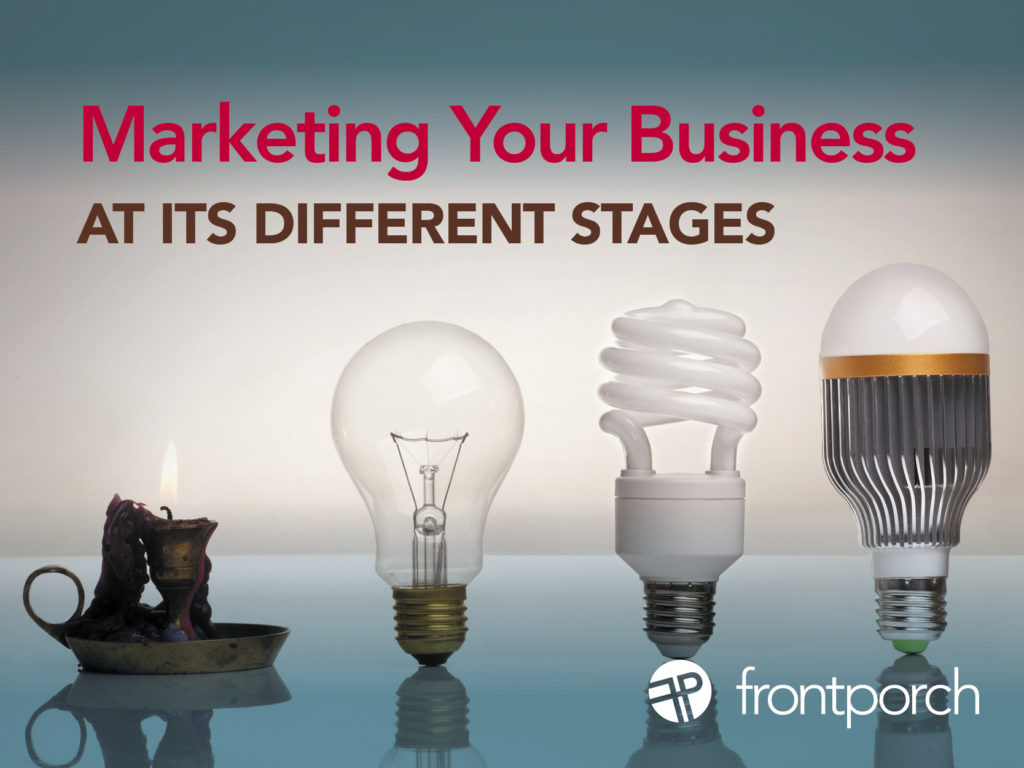
On the Porch, we are honored to market brands at different stages, from marketing plan to exit plan. We partner with businesses in start-up, growth, established and exit stages. Our team recently celebrated a business owner whose brand we evolved. This business owner sold the business to a larger company. When this happens, we take great pride in the role we had on the journey. We tangibly helped that owner and business reach their end game.

So how does marketing change at the different stages of a business? Just like a person growing from a baby to an adult, your business has different needs at every age to thrive.

Start-up Stage Marketing

Branding is paramount in this phase. Brand architecture and identity development are critical out of the gate. Once that is complete, the rest flows from there. The foundational collateral, like business cards, letterhead, and the like are developed. After that, website development and digital strategy follow.

Growth Stage Marketing

Businesses in the growth stage come to us as they are looking to target a new demographic or geography. They may expand their product or service offerings. Or the business owner wants to grow existing business. Typically, a new marketing strategy and execution are developed. This involves increasing existing marketing spend. Sometimes, rebranding is needed.

Established Stage Marketing

Your brand is established. But growth is still a desired outcome. How can you market differently at this stage to stay relevant? Updated market research and consistent data analysis are critical. Now may be the time to take risks. What haven’t you done? How can you push the envelope on creative or campaigns? Are your current marketing initiatives consistent? Do you need a brand audit?

Exit Stage Marketing

Ready to position your brand for living on its own, without you at the helm? Although it may seem counterintuitive, now is the time to invest in your brand. First, revamp your marketing strategy. Next, follow industry best practices. It is critical to be the brand authority. Then, increase brand awareness, all the while increase sales. Finally, audit marketing content. How is your website UX/UI? Do you have technical gaps? Make sure sales and marketing are aligned.

What stage is your business in?

Don’t know which one of the different stages your business is in? Let us help. However, if you do know, we can also be your branding and marketing partner. We take pride in our relationships with brands. And we are honored to work with smart, innovative business owners and leaders. So let us help you reach your end game however you define it.


Establish the 2024 Marketing Plan for Your Business

The fourth quarter is 2024 marketing plan time. And there is still time to accomplish this important business exercise to cultivate growth in your business. Are you ready for 2024? On the Porch, marketing plan meetings are set with clients through early December to get ‘er done. It keeps the business and team focused. Save valuable resources — time and money — by creating yours now. Holler if Front Porch Marketing can help!

Marketing Plans 101

So, where to start? We would be happy to help, of course. But, if you want to tackle it on your own, let us help entertain you.

  1. Start by asking yourself the question “What are your 2024 business goals?” Marketing plans should align with what your business is trying to achieve.
  2. Then, based on projected 2024 revenue, budget a percentage of that revenue for marketing to meet growth targets. Research shows that on average companies are budgeting 9–10% for this purpose, for the second year in a row, for a variety of marketing activities. Protip: companies trying to gain market share are allocating more even in these uncertain times.
  3. Once the marketing budget has been inked, set your marketing goals. Goals should always be measurable and be able to be tracked on a monthly or quarterly basis. Measuring your progress is important! Define how success will be measured.
  4. Next, analyze your company’s situation and create or update the SWOT analysis. And then, analyze where competitors sit within the space. Then, define or redefine the target clients or customers.

Bring Your Marketing Plan to Life

Now that you have the start of a marketing plan written, think about how you will fulfill it. Set your marketing strategies. Strategies are long-term and create the pathway through to the business’s mission. They drive all of the marketing activities.

Next, define your marketing tactics. Will you be using advertising? Social media? Media relations? How will you execute against your strategy? Tactics are more detailed and have a shorter time frame. And tactics are action oriented. Think of tactics as the answer to how strategies will come to life. Are there tools in place for reporting on your company’s tactical success? Who is responsible for reporting and measurement? Set your structure in place for next year.

Finally, create a marketing timeline for all these activities. What needs to be completed and when? Make notes on who is responsible for tactical execution and when.

Review What Worked and What Didn’t in 2023 to Make 2024 Better

Make sure to revisit the marketing plan from time to time. Audit last year’s efforts, and this year’s efforts to gain insight on what to do better next year. Some folks do it quarterly, some more frequently. And cheers to your business success through strategic, thoughtful branding, marketing, advertising and marketing communication in 2024!


Where Do Marketing Agencies Fit into Your Business?

In today’s competitive business landscape, marketing plays a pivotal role in driving growth and success, and marketing agencies are at the forefront of this work. Good marketing can identify new customers, engage and grow a loyal audience, or launch new products and services. And while some business owners may contemplate handling their marketing efforts in-house, seeking the expertise of an agency can make a significant difference in achieving sustainable results.

Marketing agencies bring a wealth of knowledge, experience, and strategic insights that can add substantial value to a client’s business. There are many different ways that agencies can contribute to a client’s success and why opting for professional assistance is essential.

What You Get When You Choose A Marketing Agency Over Doing it Yourself

When you work with a marketing agency instead of trying to do everything yourself, you’ll enjoy many advantages like specialized expertise, a strategic approach, resource optimization, access to cutting-edge tools, and time efficiency.

1. Specialized Expertise

Marketing agencies equip their teams of skilled professionals with specialized knowledge and skills in various marketing disciplines. From SEO and content marketing to social media and paid advertising, agencies can bring a diverse skill set that can be tailored to meet the unique needs of each client.

These marketers focus on their disciplines day in and day out, and adding their knowledge base to building your business pays off. Their expertise ensures that marketing efforts are executed effectively, delivering measurable results that align with business goals. More bang for your buck.

2. Strategic Approach

Agencies work closely with clients to develop data-driven strategies that align with their overall business objectives. By conducting thorough market research and competitor analysis, agencies identify opportunities and then craft well-thought-out campaigns to stay ahead of the competition.

A strategic approach not only maximizes marketing ROI but also enables businesses to make informed decisions for future growth. These agencies objective perspectives on growing clients’ businesses means they can make solid, research-backed decisions to build business. And then they can implement these decisions in a streamlined manner.

3. Resource Optimization

Managing marketing efforts in-house can strain resources, especially for small to medium-sized businesses. Marketing agencies offer cost-effective solutions that allow clients to focus on core business activities while leaving marketing tasks in expert hands. This resource optimization ensures that businesses get the most out of their marketing budget and manpower.

Our small to medium-sized clients benefit from Front Porch Marketing’s ability to supplement their own efforts. We work hand-in-hand with them to build their business as if it were our own, while lending expertise that clients don’t typically have in-house like website design, social media content marketing, email marketing and large design-focused projects like brochures. This leaves small business owners to focus on what they do best.

4. Access to Cutting-Edge Tools

Marketing agencies invest in state-of-the-art marketing tools and technologies to gain a competitive edge. By leveraging these tools, agencies can track and analyze data effectively, allowing for data-driven decision-making and continuous optimization of marketing campaigns. Such insights are crucial in maintaining a strong market presence and adapting to changing consumer behaviors.

It wouldn’t be cost-effective for small businesses to invest in these tools, so marketing agencies can again supplement the efforts of a business with this access to tools and the expertise to optimize their use for the benefit of a client’s business.

5. Time Efficiency

Implementing a successful marketing strategy requires time, effort, and consistent monitoring. By delegating marketing responsibilities to an agency, clients can focus on core competencies and strategic business growth. This time efficiency enables businesses to operate seamlessly while their marketing needs are efficiently addressed by industry experts.

Taking all these tasks off a small business owner’s plate gives them time to see the big picture. Then they can focus on growing their business. And they won’t get buried in the weeds of all the marketing tasks necessary to get there.

6. Reassess What Your Time is Worth, and Let a Marketing Agency Help Make Your Business Better

In conclusion, marketing agencies bring invaluable expertise and depth of knowledge. This can significantly elevate a client’s business to new heights. From specialized skill sets and strategic insights to resource optimization and access to cutting-edge tools, agencies offer an all-encompassing solution to marketing challenges.

While some clients may consider DIY marketing, it’s crucial to recognize the value that marketing agencies bring to the table. By partnering with a reputable agency, businesses can enjoy efficient and effective marketing efforts that lead to long-term success. Remember, marketing is an investment in the future, and entrusting marketing professionals can lead to remarkable returns.


Client-Agency Partnerships Require Nurturing

Client-Agency partnerships don’t happen instantly. Do you ever wonder what makes a strong working relationship between a client and an advertising agency? I’ve walked in the shoes of both and know first-hand the frustration that can ensue if there isn’t a solid relationship.

A successful partnership begins before the ink is dry on a formal agreement and is nurtured throughout the relationship. While there are many traits of a successful relationship, focusing on the following will help start a genuine connection from day one.

  1. Drive Home That You Are Partners
    It is critical from day one that both the client and the agency view each other as partners in a client-agency partnership. Both bring unique knowledge and skills to the table. The client knows their customers better than anyone and brings the overall goals, while the strategy and execution come from the agency. Everyone must work together purposefully and respectfully to make the vision come to life.
  2. Open and Honest Communication
    It’s ok for both sides to push back. Successful client-agency partners don’t always agree. Being open to honest feedback and seeing different perspectives provides a better result. Set boundaries when giving feedback. And remember, it should never be derogatory or condescending.
  3. Set Expectations and Define Success
    When establishing a new client-agency partnership, the client and agency must understand each other’s processes. Schedule an onboarding meeting to share best practices, processes and procedures, timelines, etc. It is also imperative to define success together. Everyone needs to understand the agreed-upon goals, that objectives are easily measurable, and KPIs are defined.

Team Client-Agency For the Win!

It is important to remember at the end of the day, the client and the agency are working toward the same goal. You’re a team. Yes, there will be disagreements at times. But a solid partnership built on mutual respect, trust, and open and honest communication is a winning recipe for a long-lasting and successful relationship.