Tag Archives: business owners

Trade shows and conferences offer invaluable opportunities for B2B businesses to network, showcase their offerings, and stay ahead of industry trends. However, to truly leverage these events for growth, it’s essential to have a strategic approach.

The Power of Face-to-Face Connections

In today’s digital age, the value of face-to-face interactions cannot be overstated. Trade shows and conferences provide a platform for B2B businesses to engage with industry peers, potential clients, and thought leaders in a dynamic and immersive setting. By capitalizing on these events strategically, businesses can foster relationships, generate leads, and ultimately drive growth.

1. Pre-Event Preparation: Setting the Stage for Success

Maximizing the impact of trade shows and conferences begins long before the event itself. Start by thoroughly researching the event agenda, exhibitors, competitors and attendees. Set clear objectives for your participation, whether it’s expanding your network, showcasing new products, or generating leads. Develop a compelling booth design and promotional materials that effectively communicate your brand message and offerings. Market your participation via email, social and your company’s website and blog.

2. Strategic Networking: Quality Over Quantity

While it may be tempting to collect as many business cards as possible, focusing on quality over quantity is key when it comes to networking at trade shows and conferences. Identify key stakeholders and decision-makers you want to connect with and prioritize meaningful interactions. Prepare an elevator pitch that succinctly communicates your value proposition and be genuinely interested in learning about others’ businesses.

3. Engaging Booth Experiences: Capturing Attention

Your booth is your storefront at trade shows and conferences, and it should be designed to captivate attendees’ attention. Create interactive experiences that allow visitors to engage with your products or services firsthand. Incorporate multimedia elements such as videos, demonstrations, or virtual reality experiences to showcase your offerings in an engaging and memorable way. Remember to train your booth staff to be knowledgeable, approachable, and proactive in engaging with visitors.

4. Thought Leadership Opportunities: Sharing Expertise

Trade shows and conferences often include speaking opportunities, panel discussions, or workshops where industry experts can share insights and expertise. Seize these opportunities to position your business as a thought leader in your field. Prepare engaging presentations that offer value to attendees and demonstrate your industry knowledge. Be sure to promote your speaking engagements beforehand using email and social media to attract attendees to your sessions.

5. Post-Event Follow-Up: Nurture Relationships

The real work begins after the trade show or conference ends. Follow up with leads promptly, whether through personalized emails, phone calls, or social media connections. Reference specific conversations or interactions to demonstrate your attentiveness and interest. Continue to nurture these relationships by providing valuable content, addressing any questions or concerns, and staying top of mind until conversion.

Driving Growth Through Strategic Engagement at Trade Shows and Conferences

Trade shows and conferences represent more than just opportunities for businesses to showcase their offerings; they are catalysts for growth and innovation. By approaching these events strategically, small and mid-size B2B enterprises can expand their networks, establish thought leadership, and ultimately drive business growth. By investing time, resources, and creativity into maximizing trade show and conference participation, businesses can unlock new opportunities and propel their success forward.


The holiday season is in full swing, and chances are you have already finalized the details for any holiday appreciation gifts you plan to send to your clients, but have you thought about how you are going to celebrate your team this season? If the answer is no, there is no reason to push the panic button just yet.

How to Show Appreciation During the Holidays

Showing appreciation doesn’t have to mean grand gestures or gifts. In fact, sometimes, a small act of kindness means the most. Here are a few ideas to help you get started.

  1. Handwritten Cards
    Don’t overlook the simple act of a personalized note to celebrate your team members. We live in a world where texts and emails are our main form of communication. And typically, what lands in our home mailboxes are bills and advertisements. What if your team open their mailboxes to a card just for them expressing your gratitude for their hard work and commitment and closing with a happy holiday message?
  2. Thoughtful Gift
    You may want to think about adding a small gift to your handwritten note. Remember to take into consideration what your team members like to do outside of the office. An avid reader may enjoy a new book or a gift card to purchase the newest read from their favorite author. Don’t forget to incorporate the meaning of the gift into your note.
  3. Extra Time Off Work
    What is there never enough of during the holidays? Time! This season can be stressful, and giving your team an extra day or afternoon off from work may help ease their physical or mental load. Maybe it means they can spend extra time with a loved one, finish up last-minute shopping or decorating, or just take a few hours to themselves to recharge.
  4. Celebrate Your Team With a Team Luncheon
    No, this is not a potluck team luncheon. We just talked about how time is a valuable commodity during the holidays. No one wants to add to their evening activity a last-minute trip to the store or an extra hour in the kitchen. They want to enjoy the holidays with less stress! Consider catering a meal at the office or a trip to a nice restaurant with a reserved room. If your team works remotely, a restaurant gift card or a gift basket delivery with their favorite holiday treat is a great option too.

Celebrate the Team That Supports Your Business

As you start to assemble your own ideas, keep in mind that we all want to be appreciated, especially around the holidays. Your small gesture can make a big difference. And it may create a team tradition for years to come. Happy Holidays from your Front Porch Team!


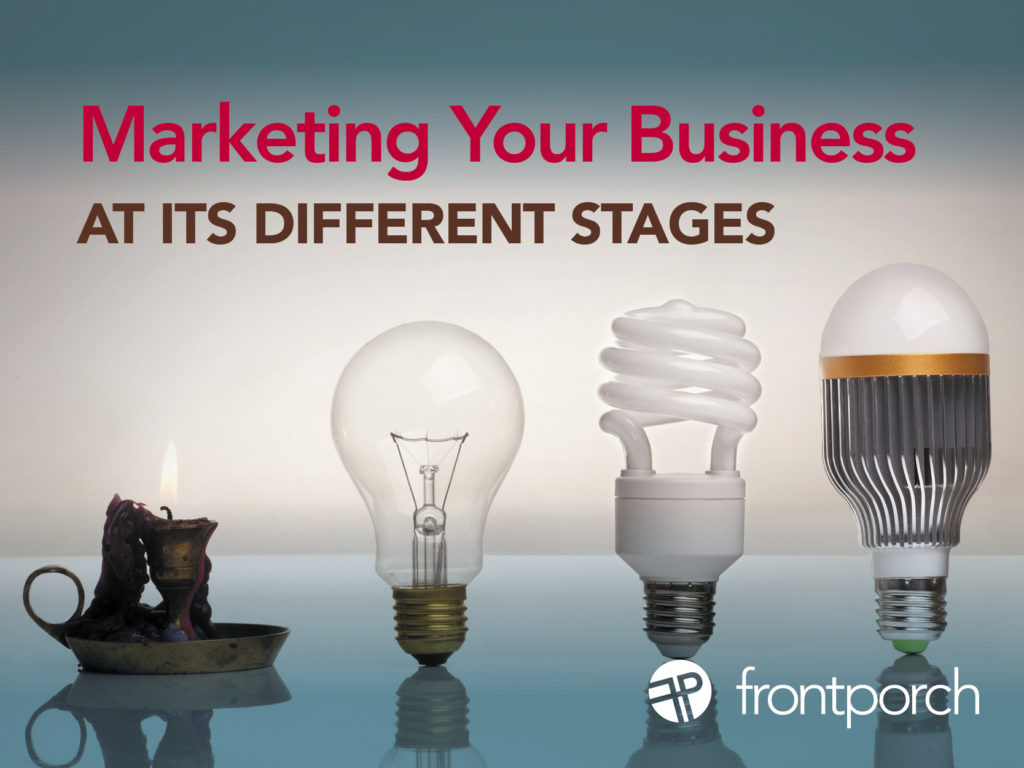
On the Porch, we are honored to market brands at different stages, from marketing plan to exit plan. We partner with businesses in start-up, growth, established and exit stages. Our team recently celebrated a business owner whose brand we evolved. This business owner sold the business to a larger company. When this happens, we take great pride in the role we had on the journey. We tangibly helped that owner and business reach their end game.

So how does marketing change at the different stages of a business? Just like a person growing from a baby to an adult, your business has different needs at every age to thrive.

Start-up Stage Marketing

Branding is paramount in this phase. Brand architecture and identity development are critical out of the gate. Once that is complete, the rest flows from there. The foundational collateral, like business cards, letterhead, and the like are developed. After that, website development and digital strategy follow.

Growth Stage Marketing

Businesses in the growth stage come to us as they are looking to target a new demographic or geography. They may expand their product or service offerings. Or the business owner wants to grow existing business. Typically, a new marketing strategy and execution are developed. This involves increasing existing marketing spend. Sometimes, rebranding is needed.

Established Stage Marketing

Your brand is established. But growth is still a desired outcome. How can you market differently at this stage to stay relevant? Updated market research and consistent data analysis are critical. Now may be the time to take risks. What haven’t you done? How can you push the envelope on creative or campaigns? Are your current marketing initiatives consistent? Do you need a brand audit?

Exit Stage Marketing

Ready to position your brand for living on its own, without you at the helm? Although it may seem counterintuitive, now is the time to invest in your brand. First, revamp your marketing strategy. Next, follow industry best practices. It is critical to be the brand authority. Then, increase brand awareness, all the while increase sales. Finally, audit marketing content. How is your website UX/UI? Do you have technical gaps? Make sure sales and marketing are aligned.

What stage is your business in?

Don’t know which one of the different stages your business is in? Let us help. However, if you do know, we can also be your branding and marketing partner. We take pride in our relationships with brands. And we are honored to work with smart, innovative business owners and leaders. So let us help you reach your end game however you define it.


Establish the 2024 Marketing Plan for Your Business

The fourth quarter is 2024 marketing plan time. And there is still time to accomplish this important business exercise to cultivate growth in your business. Are you ready for 2024? On the Porch, marketing plan meetings are set with clients through early December to get ‘er done. It keeps the business and team focused. Save valuable resources — time and money — by creating yours now. Holler if Front Porch Marketing can help!

Marketing Plans 101

So, where to start? We would be happy to help, of course. But, if you want to tackle it on your own, let us help entertain you.

  1. Start by asking yourself the question “What are your 2024 business goals?” Marketing plans should align with what your business is trying to achieve.
  2. Then, based on projected 2024 revenue, budget a percentage of that revenue for marketing to meet growth targets. Research shows that on average companies are budgeting 9–10% for this purpose, for the second year in a row, for a variety of marketing activities. Protip: companies trying to gain market share are allocating more even in these uncertain times.
  3. Once the marketing budget has been inked, set your marketing goals. Goals should always be measurable and be able to be tracked on a monthly or quarterly basis. Measuring your progress is important! Define how success will be measured.
  4. Next, analyze your company’s situation and create or update the SWOT analysis. And then, analyze where competitors sit within the space. Then, define or redefine the target clients or customers.

Bring Your Marketing Plan to Life

Now that you have the start of a marketing plan written, think about how you will fulfill it. Set your marketing strategies. Strategies are long-term and create the pathway through to the business’s mission. They drive all of the marketing activities.

Next, define your marketing tactics. Will you be using advertising? Social media? Media relations? How will you execute against your strategy? Tactics are more detailed and have a shorter time frame. And tactics are action oriented. Think of tactics as the answer to how strategies will come to life. Are there tools in place for reporting on your company’s tactical success? Who is responsible for reporting and measurement? Set your structure in place for next year.

Finally, create a marketing timeline for all these activities. What needs to be completed and when? Make notes on who is responsible for tactical execution and when.

Review What Worked and What Didn’t in 2023 to Make 2024 Better

Make sure to revisit the marketing plan from time to time. Audit last year’s efforts, and this year’s efforts to gain insight on what to do better next year. Some folks do it quarterly, some more frequently. And cheers to your business success through strategic, thoughtful branding, marketing, advertising and marketing communication in 2024!


Where Do Marketing Agencies Fit into Your Business?

In today’s competitive business landscape, marketing plays a pivotal role in driving growth and success, and marketing agencies are at the forefront of this work. Good marketing can identify new customers, engage and grow a loyal audience, or launch new products and services. And while some business owners may contemplate handling their marketing efforts in-house, seeking the expertise of an agency can make a significant difference in achieving sustainable results.

Marketing agencies bring a wealth of knowledge, experience, and strategic insights that can add substantial value to a client’s business. There are many different ways that agencies can contribute to a client’s success and why opting for professional assistance is essential.

What You Get When You Choose A Marketing Agency Over Doing it Yourself

When you work with a marketing agency instead of trying to do everything yourself, you’ll enjoy many advantages like specialized expertise, a strategic approach, resource optimization, access to cutting-edge tools, and time efficiency.

1. Specialized Expertise

Marketing agencies equip their teams of skilled professionals with specialized knowledge and skills in various marketing disciplines. From SEO and content marketing to social media and paid advertising, agencies can bring a diverse skill set that can be tailored to meet the unique needs of each client.

These marketers focus on their disciplines day in and day out, and adding their knowledge base to building your business pays off. Their expertise ensures that marketing efforts are executed effectively, delivering measurable results that align with business goals. More bang for your buck.

2. Strategic Approach

Agencies work closely with clients to develop data-driven strategies that align with their overall business objectives. By conducting thorough market research and competitor analysis, agencies identify opportunities and then craft well-thought-out campaigns to stay ahead of the competition.

A strategic approach not only maximizes marketing ROI but also enables businesses to make informed decisions for future growth. These agencies objective perspectives on growing clients’ businesses means they can make solid, research-backed decisions to build business. And then they can implement these decisions in a streamlined manner.

3. Resource Optimization

Managing marketing efforts in-house can strain resources, especially for small to medium-sized businesses. Marketing agencies offer cost-effective solutions that allow clients to focus on core business activities while leaving marketing tasks in expert hands. This resource optimization ensures that businesses get the most out of their marketing budget and manpower.

Our small to medium-sized clients benefit from Front Porch Marketing’s ability to supplement their own efforts. We work hand-in-hand with them to build their business as if it were our own, while lending expertise that clients don’t typically have in-house like website design, social media content marketing, email marketing and large design-focused projects like brochures. This leaves small business owners to focus on what they do best.

4. Access to Cutting-Edge Tools

Marketing agencies invest in state-of-the-art marketing tools and technologies to gain a competitive edge. By leveraging these tools, agencies can track and analyze data effectively, allowing for data-driven decision-making and continuous optimization of marketing campaigns. Such insights are crucial in maintaining a strong market presence and adapting to changing consumer behaviors.

It wouldn’t be cost-effective for small businesses to invest in these tools, so marketing agencies can again supplement the efforts of a business with this access to tools and the expertise to optimize their use for the benefit of a client’s business.

5. Time Efficiency

Implementing a successful marketing strategy requires time, effort, and consistent monitoring. By delegating marketing responsibilities to an agency, clients can focus on core competencies and strategic business growth. This time efficiency enables businesses to operate seamlessly while their marketing needs are efficiently addressed by industry experts.

Taking all these tasks off a small business owner’s plate gives them time to see the big picture. Then they can focus on growing their business. And they won’t get buried in the weeds of all the marketing tasks necessary to get there.

6. Reassess What Your Time is Worth, and Let a Marketing Agency Help Make Your Business Better

In conclusion, marketing agencies bring invaluable expertise and depth of knowledge. This can significantly elevate a client’s business to new heights. From specialized skill sets and strategic insights to resource optimization and access to cutting-edge tools, agencies offer an all-encompassing solution to marketing challenges.

While some clients may consider DIY marketing, it’s crucial to recognize the value that marketing agencies bring to the table. By partnering with a reputable agency, businesses can enjoy efficient and effective marketing efforts that lead to long-term success. Remember, marketing is an investment in the future, and entrusting marketing professionals can lead to remarkable returns.


Looking For More Than a Beach Read? Try One of These Marketing Books.

Building a StoryBrand: Clarify Your Messages So Customers Will Listen

Written by Donald Miller, this book is the perfect guide to strengthen your relationships and loyalty to your consumers. This book draws on the seven universal powers of storytelling. It teaches you how to craft a brand story to gain a competitive advantage in a crowded marketplace.

Building a StoryBrand is the marketing book that will transfigure the way you sell your brand. And the value it brings. It is for leaders who are wondering how to create a clear and consistent brand message. This book is the perfect read for helping you reach your audiences.

Contagious, Why Things Catch On

This book written by Jonah Berger explains the science behind how word-of-mouth and social transmission work. Berger reveals six principles of how ideas and products catch on, appealing to business leaders, politicians, health officials, and anyone trying to sell an idea or product. The book was a New York Times bestseller. It was also awarded the best marketing book in 2014 by the American Marketing Association.

For scientific and analytical thinkers, this is the best marketing book to help you understand the science behind the human brain and natural human tendencies when marketing your brand.

Hacking Growth: How Today’s Fastest-Growing Companies Drive Breakout Success

Looking to rapidly grow your brand? Hacking Growth by Sean Ellis and Morgan Brown is perfect for you. This read touches on the marketing strategy called Growth Hacking. It originated in Silicon Valley and refers to the rapid growth of a company. This book provides you with all the necessities and tools. Your teams can use it to maximize growth, customer base, and market share in a reasoned and deliberate way.

Positioning: The Battle For Your Mind

Are you overwhelming your customers with information? Are they skeptical of the over-consumption of media? Then this marketing book written by Al Ries and Jack Trout is perfect for you. The goal of this book is to keep your brand’s strengths and weaknesses in mind, and use this information to strategically position your company in the customer’s minds.

Whether you are new to the market or seasoned, this book provides you with the information to put yourself in your customer’s shoes. Make an educated approach to align your brand with your customer’s needs.

Permission Marketing: Turning Strangers Into Friends and Friends Into Customers

Seth Godin reveals his alternative marketing strategy of advertising goods and services only after getting advance consent. People do not respond positively when their lives are “interrupted” by unwanted advertisements.

This book shows brands how to effectively use permission marketing and the wide success it has had on various companies. If you are looking for a way to passively market your brand in a manner that consumers will find subtle and professional, this is the perfect book to read.


Q&A from a small business owner

Small businesses are the heart of America, but what would it look like to start a small business in the post-pandemic world of today? Life in corporate America has changed drastically since the start COVID-19 pandemic. Turnover rates have skyrocketed and a growing sense of burnout has people looking for flexible, fulfilling enterprises. So, when the 9-5 isn’t cutting it anymore, why not become your own boss?

Turn a passion into a money making machine that pays the bills and gets you out of the office. My personal friend, MJ, did just that. She created Ambrosia and Honey, an online art shop specializing in fantasy novel merchandise. I got the inside scoop on how MJ turned her drawings into a successful, growing company, as well as the hardships and victories she encountered along the way. 

1. What made you want to start your small business?

I started to read again after graduating college. I loved reading as a kid but school took up too much of my time and that passion got put on the back burner. A few months after graduation I got a job as a concept artist and was living with my parents. I had tons of free time after work and was burning through several books every week.

After 6 months working I realized that I really don’t like working for a company. No matter how cool the assignment was, I found that I could never bring as much passion to my job as I did to my personal work. I got into a bit of a bad place where I wasn’t sure what I truly wanted anymore. My goal was always to become a concept artist so why wasn’t I happy?

That was when I discovered the bookish community on TikTok and Instagram. I found so many other people that loved to read as much as I did, as well as other artists who created amazing bookish shops. I thought to myself “well I could do that.” And so I did!

2. How have your priorities changed from when you first started?

I don’t think my priorities have changed as much as my goals have. Originally I started the shop with the goal to share my art and maybe make a few extra bucks on the side to pay for gas, seeing as I drove 45 minutes to and from work every day. I was already creating fanart for myself, I figured other people might like to see it too.

Well as it turns out a lot of people like to see it and the shop is now my full time job! My current goals are more in the realm of expanding the company so I can keep up with the demand and creating even better products. My small business priority has always been quality over quantity. 

3. Knowing what you know now, is there anything you would have done differently when you were first starting out in your small business?

I would have done preorders from the start. I didn’t realize that social media engagement didn’t equal actual sales so I ordered way more product than I actually needed.

4. What has been the hardest thing about starting your own business? 

The hardest thing has probably been the accounting and business side of things. The art comes easy but the legal things you have to take care of are incredibly frustrating and time-consuming.

5. What is unique about your small business?

I think the fact I make art based on books is pretty unique. Most fan artists make work based on tv shows, films, or anime but the bookish community is relatively niche. My work itself is another thing that separates me from other bookish shops. The majority sell apparel, candles, or jewelry while I sell decor.

I combine digital painting with 3D elements to create something that’s never been done before. Of course this isn’t to say those shops are bad — on the contrary! My fellow bookish shop owners have become some of my dearest friends. I just mean to say mine is slightly different from the rest.

6. What do you look into when making a new product for your business? 

I have an entire notebook full of ideas I can’t wait to show everyone! Often times they come to me while I’m driving or when I’m about to fall asleep. That’s the easy part; scheduling is the main problem.

Due to how time-consuming each launch is, I’m only able to do one every few months so I have to be very strategic when they’re placed throughout the year. Seasons, holidays, book release dates, etc. all play in to what I choose to design and when. I definitely get inspired by my fellow bookish shops but my work is different enough from them that I generally just to my own thing.

7. How do you market your business? What is the most useful/successful?

Social media is essential to my small business! I personally use both TikTok and Instagram. Understanding how the algorithm works is the best skill you can learn in terms of marketing. Good lighting, engaging captions, and posting at the right times will take you far. If you don’t know where to start, look at other accounts to get inspiration. 

8. Any advice to someone starting a small business?

My biggest piece of advice is to be approachable! Let your followers get to know you and create a community. Post relatable content with insights into your personal life. Pull back the curtain and show what’s behind the scenes. People want to follow people, not brands.

Are you ready to start your own small business?

Starting a small business is no easy task, but it might be just what you need if you’re feeling bogged down by the corporate machine. They say if you’re good at something you should never do it for free, and if you’ve got passion and determination it can take you where you need to go. We’ve even got more tips for marketing your small business to help you get started.

Hopefully these tips can help you or someone you know who is looking to start their own small business! Huge thanks to my friend MJ. Remember to check out her shop Ambrosia and Honey online, and don’t forget to shop small!


How Do You START Marketing Your Small Business?

Marketing your small business can be an overwhelming task if you’re starting from scratch. Where do you start? What’s the most important thing? What are the marketing steps to take to get to success?

Over the years, Front Porch Marketing has written a ton of articles to help small businesses succeed — on everything from social media to marketing plans. Today we’ll gather those up in a helpful list that you can use to start marketing your small business. Even if you’re starting from scratch.

Start Your Marketing With a Plan

Before you start doing anything, you need to have a big, bad marketing plan. Why? This steering document will help you know who your audience is and what your goals are. It will help you develop strategies to succeed, and tactics to reach those people.

As months pass, though, don’t forget you’ll need to continue to cultivate your marketing plan to make it grow, much like weeding and feeding a garden. Weed out what’s not working, and do more of what is working. A Marketing Plan is a living document.

Make Your Business Look Like It Means Business

To present the best face of your business to the world, you’ll need a logo. This visual symbol of your business’ legitimacy will be a reminder everywhere — your email, your website, your invoices, your staff’s golf shirts. Designing a strong logo and implementing it is key to a strong brand voice.

Can Your Customers Find You as You Are Marketing Your Small Business?

Most businesses have a website, as their home-base on the internet. This is the first place customers will go to find you and learn more about your business. Is yours up-to-date? Or do you need to build your first website? Maybe you just need to expand your presence by adding a social media channel or two after a social media audit. Depending on who your customer is, you might choose Facebook or LinkedIn, Twitter or TikTok, to reach them.

You might also want to consider email marketing to reach your customers. Engage and connect with customers. Make their lives easier by helping them solve problems. Email marketing has power, and building your email marketing list can build your business.

Grow Your Audience With Advertising!

Reaching your consumers wherever they may be is important. So your marketing plan might likely include some form of advertising. Do you need digital advertising to reach new customers on the internet? Maybe text message marketing and advertising (SMS) to build loyalty with your existing customers. Would testimonials on your website convince others to try your company?

Establish Your Authority With Media Relations.

Some businesses benefit from having the news media write about them in editorials, reviews and interviews. Effective media relations can get great results for your business goals when done properly. Customizing your news to each publication can benefit both parties.

Start Your Small Business Marketing from Scratch By Taking the First Step

Read through some of our articles to help you get started on the journey of marketing your small business. Remember that it’s a marathon, and that you can continuously improve your approach to get better and better results. Need help with any part of your journey? We’re here to help.


Seasoned Business Leaders: You Don’t Know What You Don’t Know

As a seasoned business leader, the old adage, “You don’t know what you don’t know,” has been replaying as a reminder in my mind over and over again for the last year. Sometimes when you’ve been doing a certain thing for a long time, you might become insulated from innovation by doing things the way you first learned them. You might even forget the best practices you learned at the beginning in favor of doing what works at the moment in your business. At this point, reminders for seasoned business leaders can be helpful to continue to grow.

So this week I’m sharing here some reminders for business leaders who may need a refresher on the must-dos and must-haves when things are rockin’. And even before they’re rockin’. These apply whether you are a start-up or veteran. I was reminded this week of what I don’t know when I launched a new business of sorts, and finally brought it to life.

Seasoned Business Leader Turned Start-Up (again)

As most of those who know me know, my son is in college in Central Florida. After his freshman year and countless visits to Florida, more for my sake than his, I had an idea. Buy a place in Florida. I’m there all the time to see my son, and when I’m not there I could rent it out to others who would enjoy the beach as much as my family does.

So, I did countless hours of research. Ran numbers backwards and forwards. Consulted my business advisor. Then, did more research. Then, I contacted several owners of rental properties and local small business owners in New Smyrna Beach, Florida. Next, I refinanced the house. In addition, I had to take out another significant loan to get this idea off the ground.

As I last blogged, this is not my first rodeo. But, I am here to tell you old dogs do forget the new tricks. As a seasoned business owner, I was reminded in the course of this new project, just how much these business basics matter.

Business Leader Basics to Remember

1. Finances

Make sure you have extra in the budget for unexpected expenses during start-up. Money isn’t made in the first and sometimes second year of business. Remember that. Another thing going through my head these last few months is that real estate is a long term investment, as most businesses are. Seasoned business leaders know to endure the short term pains for the long-term gain.

2. Time

Remember that time is your inventory. Don’t go down rabbit holes. Overthinking and questioning yourself aren’t necessary. Stay focused on what matters. Make decisions and then move on. Most of all, be efficient in all you do.

3. Support Network

Partner with the experts. I don’t know construction. Or anything about the short-term rental space. Nor do know much about HOAs, (but I do now) so I found and made friends with the BEST in these categories. I am so grateful for them and their expertise. Also, my family and friends were there when I needed to vent, cry, scream or say queue #5.

4. Front Porch Marketing Team

If you have two businesses, make sure each of the business teams are in support of the other. The Front Porch team kept the Porch rockin’ while I was bobbing and weaving in and out so I could get Calming Corner (our new beach space) up and running. Seasoned business leaders build teams they can count on in crunch times.

5. Saying Uncle

Yes, you can have too much on your plate. So ask for grace. Be nice to yourself. Realize you do have physical and mental limitations.

6. Good Enough

Our first renters were to arrive at 4 p.m. on the 1st of April. There was cleaning to be done. Some pictures were not hung, etc. But the place was beautiful. It was time to finish the cleaning and save the rest for the next time she was vacant. Good enough is sometimes perfection.

“The Calming Corner” is Up and Running

I am proud to say that as we are building this rental business, we are also supporting other local businesses. The new couch is manufactured in Florida by a Florida-based company. The patio furniture is manufactured in Volusia County and the business is owned and operated by a local husband and wife duo. And our boutique vacation rental company, Florida Vacay Rentals, is owned by a local female rock star who is also my “Florida Anchor.” And I am honored to call her my friend.

So here is my shameless plug for Calming Corner, our new Front Porch view! Please note, NEW photography coming soon, because there are all new floors, paint and furniture. And there is a fabulous remodeled master bath. Shorehom by the Sea, Unit 54, also has a new bedroom pocket door, a new pantry, a new washer dryer closet and more.

Oh, and, as of April 6, it has a brand new air-conditioner, that was not in the budget … sigh.


Front Porch Marketing is now 12 years old, thanks to you. What are our marketing take-aways from the past 12 years? We value your support and confidence in us over the years! You and your brands are our jam.

Marketing Take-Aways to Help Your Business Grow

Reflecting back on client trends and opportunities, on our pearl anniversary, we share common pearls of wisdom we saw at the beginning and continue to see today. We hope these marketing take-aways spur some thinking for you!

1. DIY Marketing

It only gets a brand so far. And, once your brand is established and has credibility, DIY marketing is no longer good enough. Time to take your garage band to the main stage. Hire a professional or firm.

2. Hiring One Marketing Person to Do All the Marketing Things

There are only a handful of unicorns on the planet that can do all the things marketing. If you go this route, know they need support. A marketing generalist isn’t your graphic designer, copywriter, webmaster, etc. Give them the resources they need to do their jobs.

3. B2B Websites

We hear from business owners their websites aren’t a priority and aren’t a sales and marketing tool. Not true. What we see most often is that you aren’t closing the sale or getting to the next round of meetings because you are getting the veto vote when potential clients go to your website to validate your credibility. Important marketing take-away: your website is your virtual office. Optimize it!

4. Marketing Take-Away for CEOs, C-Suite Executives or Managing Partners

Your role is strategy, operations, finances, and managing people. We have experienced too many times when you want to get too far in the weeds managing marketing. At that point, bottlenecks happen and marketing doesn’t happen at its best or consistently.

5. Brand Architecture

Without brand architecture, your branding is inconsistent. Define your brand mission, personality, positioning and affiliation. Let all things marketing flow from there. This becomes the filter and guidepost for branding and marketing strategy as well as execution.

6. Shiny Objects

You have Salesforce, but your team isn’t utilizing it. Then you get Hootsuite and ZoomInfo and, and, and. Stop right there. Marketing operations take-away: Make sure whatever technology you currently have is being utilized to its fullest. Then, if needed, build upon that with other tools.

Marketing Take-Aways to Take You Through the Next 12 Years

Cheers to you! Thank you for trusting in us, believing in us and getting us to our 12th anniversary. Without your support, we wouldn’t be rockin’ on the Porch today and lovin’ every minute of it. We hope these 6 marketing take-aways will be helpful for your business as we grow together over the next dozen years!