If you are reading this, you are probably curious to learn more about branding! Before we dive deeper into branding, it is critical to understand how your brand represents your purpose. Brian Whipple, CEO of Accenture Interactive, says “Brands must genuinely commit to aligning their businesses with purpose to differentiate themselves.” Innovative companies such as Apple have done this, starting with the “Why?” mentality instead of “Who?” or “What?”
When businesses focus on why they are doing things, they establish purpose and garner respect. It is important to actively take steps to support your cause, because it is the action instead of words that makes a difference, and people can see this. Customers want to see companies supporting the things they support, and when this happens, they are 63% more likely to purchase.
Why it’s important
To build equity in a customer’s mind, a brand must be: memorable, meaningful, aesthetically appealing, transferable, adaptable over time, and protected legally. It means differentiating yourself and finding ways to stand out among competitors. It matters because brands stick with people!
How many times do you think you have asked for a Kleenex when in reality you meant a tissue? James R. Hupp states that people refer to tissues as Kleenex because of their well-known reputation and product quality. People become emotionally invested, and while some people will hunt around for the best deals others will stay loyal to the companies they trust.
Why you should start with branding
Brands define you from the very beginning and act as a launching pad for your business. They are a “lens through which the words and actions of a company, its competitors, and the environment in general are converted to thoughts, feelings, images, beliefs, perceptions, and attitudes, etc., about a product (or family of products).” At Front Porch we place serious emphasis on branding because if you don’t define who you are/your purpose, how will you be credible?
Is it okay to forget branding just to have something out there?
In certain rare instances, it is okay to create something just to get it out there. This would be most acceptable for smaller projects or a company who has difficulty defining its brand. If a company is truly struggling , it may suffice to take a step back and begin generating content. Hopefully somewhere in the midst of creating content that company realizes its purpose and is able to establish its brand successfully.
Key Takeaway:
Much of the value perceived by consumers is completely subjective. If you begin with branding, you will have a solid foundation that the rest of the company’s actions should follow, and you will always have something to circle back to should you stray from your brand image. We believe branding should be first always, and we would be delighted to show you how it’s done!
“It’s easier to love a brand when the brand loves you back.” – Seth Godin
Are you meeting customer expectations? We all know the importance of customer service when it comes to running a successful business. In this social media obsessed world we live in today and the age of instant feedback, excellent customer service can go a long way, but an excellent customer experience can go even further!
Until recently, the quality of product and service provided were the keys to winning customers and earning their business. But today, a new factor has come into play and that is providing the best customer experience.
A recent Walker study found that by the end of 2020, customer experience will overtake price and product as the key brand differentiator. Customers will stay loyal based upon the experience and if you can’t keep up, they will move on (bye, bye).
Happy customers remain loyal customers.
Consider these statistics:
1 in 3 customers will leave a brand they love after just one bad experience.
Research by American Express found that 86% of customers are willing to pay more for a better experience.
49% of buyers have made impulse purchases after receiving a more personalized customer experience.
Customers that rate companies with a high customer experience score spend 140% more and remain loyal for up to 6 years.
Customer experience (aka CX) is the biggest opportunity businesses have to reduce customer churn and increase revenues. The problem is, most businesses think of customer experience and customer service as one in the same when in reality, customer service is only part of the many pieces of customer experience.
Simply put, customer service is a single touch point with a brand, while customer experience includes every touchpoint a customer has with a brand from the first time they hear about you until after completing a purchase – basically the perception the customer has of a brand. While you may think your customer experience is one thing, the customer may see it as something completely different and that is what the actual customer experience is.
Managing customer perception should be the top priority for every business and having a strategy for customer experience is the best way to make that happen.
Customer expectations are rising.
The expectation is that every single interaction with a brand be the best that it can be.
Below are several strategies for creating a great customer experience:
Create a clear customer experience vision that is customer focused and can be communicated within your organization. This statement will act as the guiding principles and drives the behavior of your organization.
Collect customer feedback. It’s the only way to know if you are delivering on your promise. Try using live chat tools, conduct a focus group or send an email with a follow-up survey. Hey, even pick up the phone, for instance. In other words, get feedback, share it with the team and fix what is broken.
Develop your team to the standards of your vision. Using the feedback collected from customers, identify the training needs for each member of your support team.
Use employee feedback to improve the customer experience. Because, it’s your team who are interacting the most with your customers so give them an opportunity to share their ideas.
Measure the results of your customer experience investment. There are several metrics available for tracking customer experience over time which include Customer Effort Score, Net Promoter Score, Customer Satisfaction Score and Time to Resolution. These tools allow you to track the success or failure of changes you implement that might affect your customers.
Customer expectations are at an all-time high and word spreads fast! The importance of the customer experience increases because the customer becomes even more empowered. Customer experience is an area that needs constant attention.
Because, a greater focus on customer experience strategy, businesses will see a reduction in customer churn and an increase in revenue growth.
Need help developing your customer experience
strategy?
Now that Julie has laid down some groundwork for a great marketing foundation, let’s look ahead. What is on the marketing horizon for 2020? Here are a few possibilities:
If only there was a crystal ball for marketing…
Social Media
Yes, organic reach isn’t what it used to be, and some businesses are even pulling out of Facebook altogether. But social media continues to be a driving trend and marketing tool going into 2020.
Social media engagement looks different than it used to even five years ago. Consumers are increasingly using social media to research products and services. And platforms are delivering ad options to take advantage of this trend. Are you?
on-SERP SEO
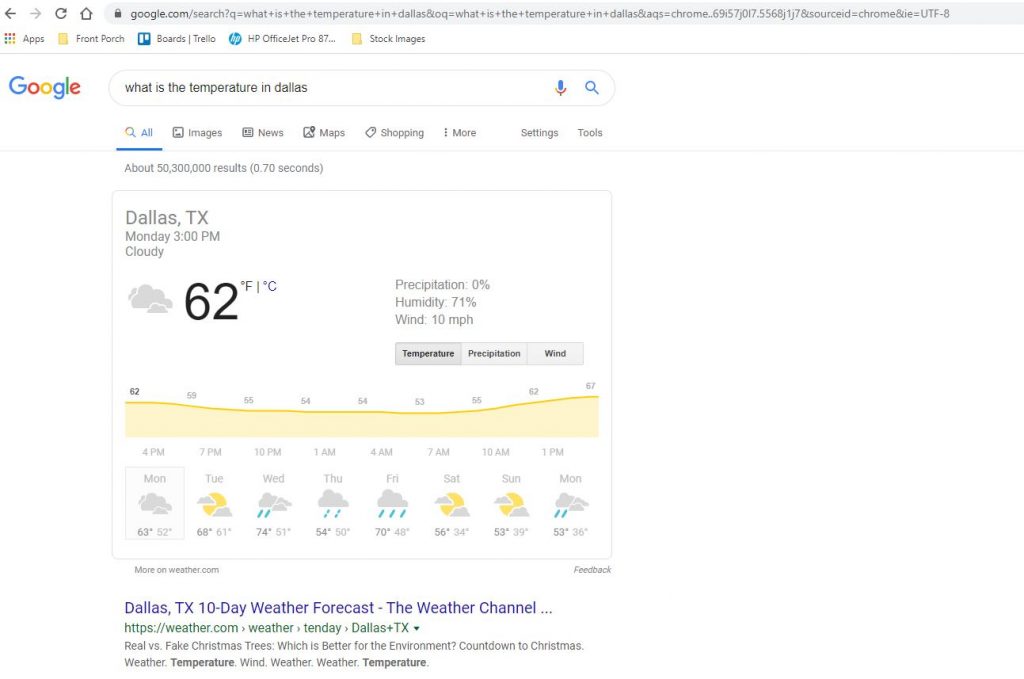
Did you know there was such a thing as a zero-click result? A zero-click result is a search result in which Google automatically provides the answer to the search query in the form of an automated snippet. See my “What’s the temperature in Dallas?” screenshot below.
Screenshot example of a zero-click result on Google.
Why is this important to marketers?
Because 61.8 percent of search results in Google are now zero-search results, according to data from Jumpshot. As a result, more and more keywords are becoming less profitable.
The automatic snippet oftentimes come from a website that ranks somewhere on page 1 of the search engine results page (SERP). But companies do not know for sure how to optimize their content so that Google chooses them over anyone else.
Marketing Silver Bullets
There is no one marketing tool to rule them all.
The marketing version of this does not exist.
According to marketing guru Neil Patel, we are all fighting for the margins now.
A lot of businesses were built off of one marketing channel… But you no longer can build a business through just one marketing channel. Good channels now get saturated extremely fast. Even if they work and cause explosive growth, it will only last for a short while before your competitors jump on board and make it harder. Marketing is now heading in the direction of being about “marginal gains”.
I know this sounds a little daunting. But I think this is a good thing. At no other time in history have small businesses had so many tools and channels to choose from to market businesses and grow their sales. Back in the dark ages of media and marketing, you had three channels to choose from and the cost of production to create and place a 30-second spot was out of the realm of possibility for most small businesses.
Now, we have a plethora of choices. Take some comfort in that. You have so many tools to choose from going into 2020. What will you choose?
As a marketer AND a business owner, I want to start the year off right and lay a strong marketing foundation for the year.
For example, we completed our 2020 business plan. We crafted our marketing plan, budget, blog schedule and content calendar.
What other components should we deploy for our 2020 marketing foundation?
For some reason, I guide marketing strategy for our clients even in my sleep. Chief Rocker, therefore, should walk her talk when marketing her own business. I am determined to do just this consistently, authentically and with purpose in 2020. Cheers to the New Year!
Four Marketing Foundation Fundamentals
Define and know your brand. A prospective client asked us recently if they needed new photography. As a result, our answer was we didn’t know. We didn’t know their brand. Communication coming from its content and leadership lacked clarity. Consequently, no connections were being made. The brand wasn’t defined. Define your brand and rock it.
Team conviction.“Be the brand, Danny.” Can’t help but quote Caddyshack here. For instance, everyone within your team believes your brand’s importance. Your company stands for a specific and important promise. Therefore, the brand and your marketing must be championed internally.
Consistency. Thirdly, deliver on your brand promise at every touch point. Inconsistency dilutes customer/client faith in the competency of the organization.
Discipline. Fourthly, stick to the plan. Meet your marketing calendar deadlines. Likewise, follow your content and blog calendars to a tee.
In conclusion, may these marketing foundation fundamentals rock your brand and top line. Use them for the New Year. Make your brand come alive for everyone it touches.
And now for the second installment of our two-part series on The Great 8 of Marketing Success. Numbers 5-7 are distinctly digital in nature and deal with how you can communicate and meet your customers where they are. Our last recommendation caps off our series with a decidedly human touch.
Number 5: Website
Prospects – both clients and candidates – are going to your website to validate your company and expertise. Make sure you are communicating your point of differentiation and your brand personality.
Most service sites look the same, sound the same and make
the same mistakes. Take a look at your website and see if you can take it to
the next level:
Eliminate the word “we.” Replace it with “you”, “your”, “our clients”, or “our candidates.” It seems like a small distinction, but you might be surprised by how much more customer-centric your copy will sound once you replace one word.
Include links to your social networks. And if you already have links to your social networks – great! Are they up-to-date? Or do you still have a link to your Google+ account? ( Hint: you might want to delete that one.)
Sell results and testimonials. Third party endorsements go a long way and potential customers want to see the value you can bring to their company.
Use minimal stock photos. We get it – when you were getting your website off the ground, you used whatever you had on hand to get it done. But stock photos can reduce the credibility of your company and take from the authenticity of your brand. Make the investment and book a professional photographer.
Optimize the site for mobile. No one likes to pinch and zoom on their phone when they are trying to view a website. And increasingly, Americans of all ages are likely to say that they mostly access the internet on their smartphone.
Make it easy for people to contact you with a form and make sure your phone number and email address are front and center.
Number 6: Social Media
Consumers are increasingly using social media to not only connect with friends and family, but also with brands. Social media is increasingly influencing consumers’ buying behavior:
When consumers follow a brand on social media, 67% of consumers are more likely to spend more with that brand.
Social media can drive retail foot traffic: 78% say they will visit that brand’s physical retail store.
These results become even more pronounced when you narrow in on millennials: 84% said they were more likely to buy from a brand they follow on social media.
But, don’t count out older folks – young people may have been early adopters of social media, but older adults using social media has increased as well.
It’s easy to be overwhelmed by social media. That’s why we
recommend narrowing your focus and pick two social networks to be active on
daily. Most social networks are monetizing their platforms so organic social
media, i.e. free, is becoming less effective, which is why you must be active consistently.
But which platforms should you choose? It depends. We recommend meeting your customers where they are. With almost a third of the world’s population using Facebook, the 500-lb. gorilla in the room might be a given. If you have an aspirational brand whose customers skew female and under the age of 49, Pinterest or Instagram may be a good fit. If you are more of a B2B company, look at joining YouTube, LinkedIn or Twitter.
Also, make sure you are connecting with the people you meet,
whether you are introduced virtually or in person. Utilize both your personal
timeline and create a company account if you don’t already have one.
Number 6.5: Social Media Content
As for content, have you ever been to a party and you were cornered by that one guy who talks about himself all night? Don’t be that guy.
Instead follow the rule of thirds: 1/3 of your content should be devoted to sharing content, 1/3 to engaging with others and 1/3 promoting yourself. Share open positions at your company, business successes and company news, just don’t let all your content be about you.
Number 7: Email Marketing
Email marketing doesn’t have to be crazy complicated or
expensive. Email marketing is inexpensive and effective. If done correctly, you
will be surprised at the results you see after every send.
Use a simple automated platform like MailChimp and send an
email to your audiences once a month, or if you are just starting out, once
every other month. Make sure you are updating your databases and are not
sending the same content to both your clients and candidates.
Target your content to the reader and use your email
marketing to establish yourself as a thought leader. Share information and
expertise. This is especially true for B2B businesses; email marketing is most
effective if you are sharing news people can use. At Front Porch, this is the
direction we choose to take with our email newsletter. We offer marketing advice
and highlight our clients.
Similarly to social media, do not use email marketing to talk 100% about your company or you. It will not work.
Number 8: Networking
We are very fortunate to have several places to network in
North Texas – industry associations, chambers of commerce, community
organizations and the list goes on.
In deciding which group is right for you, consider these things:
Can I learn and grow?
Are this group’s values aligned with mine?
Can I contribute my knowledge and skills?
Do we have common interests?
When you are at these meetings or events, remember:
Give to get. Focus on what you can do for others, not what they can do for you.
Make sure you have business cards. (I know that sounds obvious, but you’d be surprised.)
Ask questions and listen.
Follow up. Sometimes this is the hardest thing to do because we are all wearing so many hats, but it is important to connect on LinkedIn with people you met, send them an email and if the situation calls for it, send a handwritten thank you note.
As business owners, we need to network. We need to work “on”
our business as much as possible, not in our business.
Networking is a process. Remember that most business owners are looking for connections. Make time to network intentionally. Be bold and step forward into their world.
I urge you to not “go big or go home,” but as we tell our
small to mid-sized clients, “Fewer. Deeper.” Do a couple of things well and
knock it out of the park.
If you do your marketing well, then your target audience will come to trust your brand. Trusted relationships develop into emotional bonds that are hard to break. Consequently, loyalty to your brand means greater business success and reduced competitive threat.
Remember The Great
8. Engage your clients and candidates and turn them into customers and brand
ambassadors.
A two-part series where we will explore 8 great ways you can market your company.
Marketing in many people’s minds conjures up glamorous images of flashy and expensive campaigns. The reality of effective marketing couldn’t be further from the truth.
Welcome to The Great 8 of Marketing Success! This is a two-part series where we will explore 8 great ways you can market your company.
And the best part? They are all extremely effective and low-cost.
Great marketing doesn’t have to be expensive.
Number One: Differentiation
What differentiates your offering from that of your competitors? If you don’t have a strong point of differentiation, the only option is to compete on price. That isn’t where you want to be.
Your point of differentiation is not customer service. We are all in the service business. It is a given.
Define what sets your company apart from the competition. Ask yourself:
What is a superior performing aspect or expertise of your brand that has multiple customer benefits?
What do your clients really appreciate about your service?
Why are long term clients still with you?
What was one of the nicest things a client ever said about how you conduct business?
Number 2: Brand Personality
Your brand must be both differentiating and emotionally relevant. Human beings buy based on their emotions and justify their decisions with logic later. How do you connect with your customers on a more human level? By infusing your brand with its own personality.
The purpose of brand personality is to capture the human characteristics that build and enhance a relationship between brands and consumers.
These characteristics, when executed consistently, make a brand likeable. This is particularly valuable for marketing because it determines whether the look and feel of the execution is right. If a communication does not pass our “personality test,” then the consumer should never see it.
Companies who invest in their brand enjoy the following benefits, to name a few:
Higher price points and less pricing pressure
Greater market value
Reduced competition
Increased business opportunities (partnerships, licensing deals, acquisitions)
Define your brand personality. What four to five adjectives define your brand?
Number 3: Marketing Plan
Marketing plans serve as a roadmap, with measurable goals and defined tactics outlining how you will reach those goals. A marketing plan also:
Determines your marketing budget for the year
Ensures that your company will be proactive and not reactive
Keeps you focused on your target clients and customers. You can’t be relevant to everyone.
Organizes your time and priorities
Components of a marketing plan include:
Market research
Target market
Positioning
Competitive analysis
Metrics / Goals
Strategies
Tactics
Budget
You need a roadmap, a marketing plan, to maximize your resources. Remember, hope is not a strategy. Having a sound marketing roadmap is.
Number 4: Business Card
Yes, even in today’s tech-savvy world, business cards are still relevant. We have all been in a place where the Wi-Fi connection was weak, or our cell service was spotty. It’s oftentimes easier and faster to hand someone your card.
Business cards create a quick first impression of your company. If they are different and/or cleverly designed, they can also set you apart from your competition.
Great marketing includes many things.
Stay tuned for the Great 8, Part II. We’ll explore four more effective, low-cost ways you can market your company.
“Play the long game” and “It’s a marathon, not a sprint” are common phrases we have all heard. In the marketing world, traditional marketing focuses on acquiring new clients and sales. But the “long game” is relationship marketing, which cultivates existing customer relationships to create a loyal, long-term base. The focus is on building repeat business through brand loyalty. Think retention vs. acquisition.
Why is relationship marketing critical to your brand?
Research has shown that revenue may be increased by as much as 25-95% with as little as a five percent increase in customer retention,
When you cultivate your existing relationships and develop a loyal following, those customers will refer their friends and family. This saves you time and money. Word-of-mouth is free marketing, making your loyal customers great brand ambassadors.
While the focus of relationship marketing is retaining customers, “Good relationship marketing should appeal to the random viewer as powerfully as it appeals to your long-term customers.” writes Caroline Forsey in this Hubspot blog. Ensure your customers can grow with you over time.
Here are five tips she offers for a successful relationship marketing strategy:
Focus on personalized customer-service.
Meet your customers where they are.
Offer incentive and rewards for customer loyalty.
Create valuable content that tells a compelling story.
Collect feedback regularly.
The brand-customer relationship takes time to build and work to maintain. Market to your customer by getting to know your customer. Keep things fresh. Offer new content and diversify both your content and your platforms.
Customer loyalty is hard-earned. Play the long game to score the most points.
Without a defined marketing strategy, a company runs the risk of chasing marketing tactics that might not work. It’s tempting to chase every trend or try to do #allthethings. But it’s far better to focus on executing a few things right than to try to do everything and accomplishing nothing.
Take a step back and give some serious thought towards your marketing strategy.
Strategy First
The terms strategy and tactics are frequently used interchangeably but they are not the same thing. A company’s strategy will define the marketing tactics they should use, not the other way around.
At the core of every marketing strategy are five things: goals, a value proposition, target audience, competition and your marketing messages.
Goals Choose goals that are SMART, or Specific, Measurable, Attainable, Relevant and Timely. Having SMART goals keeps you and your team accountable.
Here are some examples of SMART goals:
Grow e-newsletter list to 50,000 subscribers by the end of the year.
Increase website traffic by 50% with SEO and content efforts.
Convert and capture at least 1,000 leads over the next three months.
Value Proposition What value does your product or service bring to your customers? How is your company different from your competitors?
Target Markets “Everyone” is not a target. Think about the annual income of your target customer, where they hang out online, age or stage of life, what industries they work in, education level, and their motivations for buying your product.
For B2B customers, this may look slightly different. What is the annual revenue of your target client? Who makes the purchasing decisions for the product or service that you sell?
Competition Identify and know the competition. Run a competitive analysis and/or create a competitive profile matrix. Know what your company is doing that is both different and better than the competition. Define your competitive advantage.
Marketing Messages Your marketing messages should be tailored to all your target markets. A message directed at a CTO of a Fortune 500 company will look different than a message for the CMO of a tech startup. Adjust your messaging accordingly.
Tactics Second
Now we get to play in my sandbox, marketing tactics. Here are a few tactics to consider:
Social Media I’m surprised by how many businesses are still wary of using social media to promote their organizations. If you don’t think that your target customer is on social media, check out these stats from the Pew Research Center:
69% of U.S. adults use Facebook. And its not just for kids anymore – among Americans 65 and older, almost half use Facebook.
73% of U.S. adults use YouTube. YouTube is the second largest search engine in the world behind Google.
A quarter of U.S. adults use LinkedIn. The growing network is a great place for B2B marketing leads, growing thought leadership, and finding your next employee.
So, basically, if your ideal customer or employee is breathing, it’s time to pick a social media channel or two and start getting social.
Influencers If you can’t build a huge audience, then buy it: this is the thinking behind influencer marketing. But, the right influencer for your company doesn’t have to necessarily have the biggest following to be effective.
Influencer marketing isn’t just for lifestyle products like makeup or the latest diet fad. Check out how this welding products company created their own influencer program.
Video More than 50% of consumers want to see videos from brands – more than any other type of content. There are many different types of videos a company could create: demo videos, expert interviews, explainer videos, and list goes on.
It’s easy to get caught up in the day-to-day demands of your company. Most entrepreneurs are too busy working “in” their business to work “on” their business. But, don’t you think its time to work on your business?