Good question! You’ve heard about “Lead Generation” but aren’t sure what that is, how to do it, or if it can help you build your business, right? As a marketing firm that works on lead generation strategies and programs all the time, we’re here to answer your questions. So ask yourself these questions next:
Interested in investing in the expertise of what a strategic, seasoned marketing partner can provide for your overall brand? Good. Read further.
Ready to invest the resources, time, money, etc. to get there? Better.
Know that the fundamentals of a brand architecture, brand strategy, message map, creative brief are key? Your competition and target customer are defined? Best.
Over the past two weeks, we have had new prospects reach out to us regarding lead generation. So, let’s rap about that specifically.
Let’s Get Started
What is it? Lead generation is the process of attracting and engaging your target audience. And then, converting them to customers. Engage your prospects. Build relationships. Turn leads into loyal customers. And loyal customers translate into sales.
Lead Generation Winning Strategies
There are lots. There is no silver bullet, one size fits all. Once all documents are reviewed and goals and target are considered, we recommend the right strategy for each business we work with at Front Porch Marketing.
Let’s name a few:
Content Marketing. This really should be part of any of the processes below. It hits many buckets: social media, website, SEO and inbound marketing. Providing consistent, relevant content of value and establishing cred and authority with your prospects.
Conversion Rate Optimization (CRO) and on page. This has to do with your website. Think forms, widgets and pop-ups to attract website visitors and produce leads by collecting information like email addresses for follow-up, or addition to a monthly newsletter.
Customer Relationship Management (CRM). Platforms and tools — i.e. LinkedIn Sales Navigator, PipeDrive, Salesforce, ZoomInfo — can help identify and reach the optimal target audience for your business. Once you reach your audience these tools also help you nurture them. Turn them into loyal customers via email, SMS and other one-on-one relationship building communications.
What’s Your Next Step?
Our clients reap success using these strategies and tools. We can share success stories related to any of the bullets above. And, we are here to help you. Let us implement a repeatable process of lead generation and then scale it with strategies and tactics to grow your topline.
Small businesses are the heart of America, but what would it look like to start a small business in the post-pandemic world of today? Life in corporate America has changed drastically since the start COVID-19 pandemic. Turnover rates have skyrocketed and a growing sense of burnout has people looking for flexible, fulfilling enterprises. So, when the 9-5 isn’t cutting it anymore, why not become your own boss?
Turn a passion into a money making machine that pays the bills and gets you out of the office. My personal friend, MJ, did just that. She created Ambrosia and Honey, an online art shop specializing in fantasy novel merchandise. I got the inside scoop on how MJ turned her drawings into a successful, growing company, as well as the hardships and victories she encountered along the way.
1. What made you want to start your small business?
I started to read again after graduating college. I loved reading as a kid but school took up too much of my time and that passion got put on the back burner. A few months after graduation I got a job as a concept artist and was living with my parents. I had tons of free time after work and was burning through several books every week.
After 6 months working I realized that I really don’t like working for a company. No matter how cool the assignment was, I found that I could never bring as much passion to my job as I did to my personal work. I got into a bit of a bad place where I wasn’t sure what I truly wanted anymore. My goal was always to become a concept artist so why wasn’t I happy?
That was when I discovered the bookish community on TikTok and Instagram. I found so many other people that loved to read as much as I did, as well as other artists who created amazing bookish shops. I thought to myself “well I could do that.” And so I did!
2. How have your priorities changed from when you first started?
I don’t think my priorities have changed as much as my goals have. Originally I started the shop with the goal to share my art and maybe make a few extra bucks on the side to pay for gas, seeing as I drove 45 minutes to and from work every day. I was already creating fanart for myself, I figured other people might like to see it too.
Well as it turns out a lot of people like to see it and the shop is now my full time job! My current goals are more in the realm of expanding the company so I can keep up with the demand and creating even better products. My small business priority has always been quality over quantity.
3. Knowing what you know now, is there anything you would have done differently when you were first starting out in your small business?
I would have done preorders from the start. I didn’t realize that social media engagement didn’t equal actual sales so I ordered way more product than I actually needed.
4. What has been the hardest thing about starting your own business?
The hardest thing has probably been the accounting and business side of things. The art comes easy but the legal things you have to take care of are incredibly frustrating and time-consuming.
5. What is unique about your small business?
I think the fact I make art based on books is pretty unique. Most fan artists make work based on tv shows, films, or anime but the bookish community is relatively niche. My work itself is another thing that separates me from other bookish shops. The majority sell apparel, candles, or jewelry while I sell decor.
I combine digital painting with 3D elements to create something that’s never been done before. Of course this isn’t to say those shops are bad — on the contrary! My fellow bookish shop owners have become some of my dearest friends. I just mean to say mine is slightly different from the rest.
6. What do you look into when making a new product for your business?
I have an entire notebook full of ideas I can’t wait to show everyone! Often times they come to me while I’m driving or when I’m about to fall asleep. That’s the easy part; scheduling is the main problem.
Due to how time-consuming each launch is, I’m only able to do one every few months so I have to be very strategic when they’re placed throughout the year. Seasons, holidays, book release dates, etc. all play in to what I choose to design and when. I definitely get inspired by my fellow bookish shops but my work is different enough from them that I generally just to my own thing.
7. How do you market your business? What is the most useful/successful?
Social media is essential to my small business! I personally use both TikTok and Instagram. Understanding how the algorithm works is the best skill you can learn in terms of marketing. Good lighting, engaging captions, and posting at the right times will take you far. If you don’t know where to start, look at other accounts to get inspiration.
8. Any advice to someone starting a small business?
My biggest piece of advice is to be approachable! Let your followers get to know you and create a community. Post relatable content with insights into your personal life. Pull back the curtain and show what’s behind the scenes. People want to follow people, not brands.
Are you ready to start your own small business?
Starting a small business is no easy task, but it might be just what you need if you’re feeling bogged down by the corporate machine. They say if you’re good at something you should never do it for free, and if you’ve got passion and determination it can take you where you need to go. We’ve even got more tips for marketing your small business to help you get started.
Hopefully these tips can help you or someone you know who is looking to start their own small business! Huge thanks to my friend MJ. Remember to check out her shop Ambrosia and Honey online, and don’t forget to shop small!
Successful email marketing can be a cost-effective way to market your business. When done right, you’ll be keeping your brand top-of-mind and become a trusted resource for your customers. They’ll look forward to your emails because you’ll be sharing your knowledge and solving their challenges.
Keeping your audience engaged with email marketing, as a part of your overall marketing strategy, is an excellent way to introduce new products, solve an on-going pain-point for customers, give a tutorial, keep your customers up-to-date about the industry, and more.
How Do You Do Successful Email Marketing?
There is a lot to designing an effective and efficient email campaign to be successful. The most important question to ask yourself: Are you leading with the audience in mind? Everything you do should be from THEIR perspective. It’s for them. Help them. Guide them. Solve their problems.
Then ask yourself: Are you overselling? Your brand and your products do not always need to be the hero in email marketing. Afterall, this is an on-going dialogue you’re having with your customers. Establishing a relationship is a longer-term proposition. Don’t oversell. Again, be helpful. Put yourself in their shoes and ask yourself: What do I need? What will make my life easier or better?
Getting Started With Email Marketing: Do This Not That
Your email marketing is a fail if it doesn’t contain these four elements. Set yourself up for success by making sure these four things are included thoughtfully in each email you send:
Look professional — Make sure the email platform template is set for your brand fonts and colors. Design is key to successful email marketing as well — design a nice header and footer. Link to your social channels in your footer. Stay consistent from month to month with this template and your customers will start to recognize your email and your brand, and look forward to your next email.
Have a call to action — What can readers do to learn more? Use a button in your email that links back to your website where the reader will read more, download something, watch a video, contact you for more information or order a product. For instance, if you are linking to a blog post, tease them in the email, but don’t reveal the real scoop…ask them to “Read More” and click the button to go to your website for the rest of the insight.
Date and time — When do users want to engage and not unsubscribe? Many email programs like Mailchimp will tell you when the best time is to send emails to be successful. Statistically, Tuesday mornings are the day most people open their emails.
Don’t try too hard to sell — Engage your audience and don’t make the email be all your company. Again, be helpful: share hints, tips, tricks. Give away your knowledge and they’ll see you as the industry leader and come to you to solve their problems (with your products or your service.
Most Importantly: Be consistent.
Successful email marketing campaigns provide content to make readers’ lives better. They are informative, not sales-y. Email marketing campaigns provide value, real value, to customers’ lives consistently. Create a schedule using Google Sheets and plan each month’s topic, date, and assign responsibilities. After a while, it becomes easier and easier to stick to your schedule and create smart, thoughtful, nicely designed emails that make your brand the one that customers turn to again and again.
The definition of remote work (also known as work from home or telecommuting) is a type of flexible working arrangement that allows an employee to work from a remote location outside of a company office.
If you’re a Gen Xer like me, working remotely wasn’t in the realm of possibilities when you entered the workforce. You commuted Monday through Friday to your office. If you were lucky, you might have had a laptop and the ability to work from home one day a week. Video conferencing? What’s that? You sat in a conference room face to face with your colleagues. Jeans at work? Only on Fridays.
The Workforce Has Changed Tremendously
Fast forward to 2022, and the pandemic made many companies realize that employees don’t need to be located in the same building to be productive. And, because of this, more and more remote jobs are emerging worldwide every day. Here at Front Porch Marketing, we’ve always been remote, and it rocks!
For many people, gone are the days of worrying if you are going to be late to a meeting because you were stuck in traffic. Business casual and casual Fridays are a thing of the past. It’s business on the top, sweatpants on the bottom. Want to work in a different location? Just change your virtual background on Zoom. Work lakeside. Work from the beach. The options are endless.
Overcoming the Pitfalls of Remote Work
Working remotely definitely has benefits that can range from eliminating a long commute to more control over your work hours to spending more time with family. On the other hand, it can also have drawbacks. Whether you’re a long-time pro of telecommuting, or new to the game, let’s talk through three of the pitfalls people make working from home and what you can do to avoid them.
1. Not having a dedicated workspace.
While not everyone has an extra room in their home for a dedicated home office, it’s important to find a space that is free of distractions. Setting up camp from your couch or bed is ok from time to time, but is not advisable for the long term because it lessens your productivity and blurs the lines between work and home.
Think of your work space as your home cubicle. Maybe it means rearranging your bedroom to make room for a desk and chair. Or, do you have a breakfast nook or dining room that no one uses? If so, make it your own with a fun lamp and a picture or two, but most importantly, keep it simple and organized and solely focused on work. This home office environment allows you to set firm boundaries between work and home.
2. Household distractions.
Having the ability to do a load of laundry, being home for a repairman, or putting dinner in the crockpot are all benefits of working from home. But, if you’re not careful, you’ll find yourself wasting a good chunk of your day working on household responsibilities instead of your work task at hand.
Utilize your work calendar by scheduling breaks and a dedicated lunch hour. Use short breaks time to take out the trash, fold a load of laundry or prep kids’ lunches for the next day. Your lunch hour is also a great time to run a quick errand, or get your blood flowing and go for a walk around the neighborhood. If you plan out your time, you’ll find at the end of the work day you have accomplished your work responsibilities and freed up some time in the evening by checking off a few nightly chores from your to-do list too.
3. Work-life balance.
If you are accustomed to being in an office, you more than likely are used to a set start and end time. Sometimes you might go in early or stay late, but typically when you leave the parking garage your work day is over. This isn’t the case when you work remotely.
While flexible hours are a benefit of working from home, it’s important to set boundaries. For some that might mean a set start and end time. Log in at 8. Log out at 5. For others, it might mean working chunks of hours to accommodate kids’ schedules. Whatever your work hours are, when you aren’t working log off your computer and turn off email notifications on your phone. Let your colleagues know this time is dedicated for family or personal time. When you have a balance, and time to disconnect, you will find you are happier and more productive while you’re working.
Remote Work is Here to Stay
It may take time to get used to a remote work environment, and find the schedule and tools and resources you need to be successful. Just know that more than likely you are not alone. Reach out to your colleagues and friends and family. They might have some tips and tricks to help too!
Our new high school interns Abby and Anna will be joining us on the Porch this summer.
Everybody say hello to our interns from Ursuline Academy of Dallas. Every summer we host interns from this high school, and give them a little taste of what a professional marketing career might look like. They’ll be visiting clients, creating content, researching topics, preparing branding documents, learning some analytics and PR skills, and we’ll even have them write a blog post here on our blog. We are proud to support and mentor the next generation of Ursuline Academy students, as we have for the past seven years.
We asked our Ursuline interns Abby Sanders and Anna Wilson a few “get to know you” questions, so y’all could learn more about their GenZ perspective.
Ursuline Intern Abby Sanders
1. What makes you want to have a career in marketing? I have always been really creative and have a playful sense of humor. I believe that marketing may be a good way for me to be able to express these traits while pursuing a career I enjoy.
2. What is one of the biggest lessons you have learned so far in your life? During the pandemic, I learned the value of not stressing out over the small things and how much I should value the time I have with others.
3. If you could describe yourself in three words what would they be? Friendly, Optimistic, and Hard-Working
4. What are your goals for your time at Front Porch Marketing? I am really excited to learn about what a profession in marketing would look like and develop skills that will be helpful throughout my life.
5. If you could go to dinner with one person living or dead, who would it be? I would choose Walt Disney because he followed his dreams and pursued his passions to become immensely successful doing what he loves. My family and I love to go to Disney World, so I would love to meet the man that made those bonding experiences possible.
6. What is a fun fact about you? I love to travel with my family and I have been able to visit 7 different countries!
Ursuline Intern Anna Wilson
1. What makes you want to have a career in marketing? I want to have a career in marketing because I love social media and understanding people. Marketing is always growing, especially with the influence of social media. It allows people to gain so much information all in one place. I also find it fascinating the way people consume information and how one Tik Tok can immediately make someone buy a product.
2. What is one of the biggest lessons you have learned so far in your life? One of the biggest lessons I’ve learned is that balance is a necessity is all aspects of my life. Whether that be between school and my social life, or making time for myself, I feel the best, and do the best work when I do not overwhelm myself with one thing.
3. If you could describe yourself in three words what would they be? In three words, I would say I am enthusiastic, caring, and determined.
4. What are your goals for your time at Front Porch Marketing? My main goal at FPM is getting exposure to the marketing world. Seeing as marketing is not a class in high school, I want to learn as much as possible through real world experiences.
5. If you could go to dinner with one person living or dead, who would it be? I would go to dinner with my grandma to hear her advice and understand her life from my current, older perspective.
6. What is a fun fact about you? One fun fact about me is that I love cows and think they are really funny!
The beginning of this decade has been a tough one. No one expected a pandemic in the 21st century. At least not one that would impact the way we live, learn, and conduct business. Covid-19 has forced humanity to adapt to the era of online learning, and remote work. Now that we have all had a taste for what its like to work at home I don’t think we’re going back to the office anytime soon. Or at least not back to full time positions in an office. In 2021 America experienced a momentous event: everyone started to quit their jobs. Journalists have called this “The Great Resignation”.
Following this, major companies in marketing and other knowledge industries like HubSpot, Twitter, Airbnb, and Microsoft announced that they’re switching to going fully remote or remote/hybrid. Due to this transition, more companies have started to look towards future advances in a new era of work. What comes next? The Metaverse.
What is the Metaverse?
So what is the Metaverse? The Metaverse is a virtual 3D world that can be accessed by using either a VR headset or through a computer. Its goal is to create a world that is more layered and connected than the internet. It will allow users to create their own avatars and converse with one another, making remote projects significantly more efficient.
What Might Business in the Metaverse Look Like?
So how does this effect businesses like marketing? Well, to start off, one of the many challenges in working from home is communication. It takes a very well structured team with consistent communication and clear goals to make remote work flow efficiently. The Metaverse would only help this work style. It would allow for more open communication and allow people to separate their home life from their work life.
Often times people blend their work life with their home life when they work remotely, and this would solve this problem. You would simply say good bye to your coworkers once work is done in this virtual world, and log off. You would no longer have this distance problem. And be able to have more effective collaboration while you’re there. Just imagine everyone having a shared virtual space where you can freely move around. It could be the future of remote brainstorming sessions.
Having a Metaverse office might also allow companies to save time on trainings. With this new technology managers will be able to train new employees at a much faster rate. Instead of just sending them a standard pdf of the tasks they need to complete, they could jump into a virtual simulation that has been specifically designed and tested to maximize their efficiency. The possibilities are endless.
Is the Metaverse a Necessary Change?
It may seem like a sudden and drastic change, but that’s what life has been like these last two years. And as humans, we continue to adapt to all of these sudden changes. I think the way we look at work — at least in the corporate setting —has forever changed since 2020. “The Great Resignation” is proof of it. It may take awhile for companies to change, but I believe there is no going back to fully in-person at the office in the future. I think you could compare this time period to a time in history when we stop using horses and started driving cars. It was a sudden drastic change that the world was not expecting, but over time it just became the new normal. You can either adapt and stay up with the times and join your colleagues in the Metaverse, or stay behind. There’s no moving backward now.
Marketing leaders, what are you doing to nurture relationships with your customers?
Consistency and connection nurture relationships. Sure, loyalty and points programs are tactics that bring brands and customers closer together.
But genuine allegiance is an outcome.
A recent conversation with a marketing leader provided inspiration. This marketing leader has had some challenges. But realized the value of marketing.
The company had cut the marketing budget. All the momentum that person built was put to a halt. And then the company brought in a consultant. First, he asked her what was happening on the marketing front. To which she replied, “Nothing.’ And, obviously he was shocked.
How to foster genuine relationships.
Business leaders do these four things:
Conviction – Know the brand. Marketing leaders walk the talk. And they demonstrate it every touchpoint. Then, clients and their customers can see it and feel it.
Consistency – Do you have a message map for your client? Share the value proposition of the brands you work on, on every platform, consistently.
Communication – Know your audience. Then recognize: how do they want to communicate? It isn’t about you. It is about what works for them. Marketing leaders will recognize this and pivot messaging to solve clients’ problems in a way that is meaningful and relevant to the client.
Connection – If there is consistency communicating the message, then the connection will happen. But as a marketing leader, how do you deepen the ties with your client and their customers?
Weekly meetings with clients
Weekly catch-up calls on both status of projects, and how pain points with consumers are being addressed
Notes on special days to recognize achievements
Boundaries set on both sides, so that both marketing and client are set up to succeed
Marketing leadership: Take inspiration. Deepen connections. Accelerate growth.
We love to partner with smart leaders who value marketing. And, if we can help, let’s talk about mutual partnership to grow top line sales.
AHAs and WHOAs. When the way the world of work is done shifts, like it did Q1 of 2022, you can expect a little bit of both. Our annual team kick off meeting this year was an AHA for us! Unfortunately, not everyone could make it. But it was the first time for us to meet two team members in person. They had joined us in 2021, but we had not all met in person yet. Such a great AHA moment!
We were also so excited to be onsite with our client last week. Their manufacturing facility inspires. Yes, we creative individuals love being in this environment because we can have lots of AHA moments together. Then, some of us go into a cave for a few hours after to recharge, taking all that inspiration with us to create. That meeting was the first time we met our client of several months in person vs via a screen. We hugged, natch.
WHOA, I’m not sure I’m ready for this.
In a catch-up lunch, Friday, a longtime advocate of ours was very anxious. And he admitted, he’s a bit angry. He starts international business travel again full throttle this week. He liked his pandemic routine. WHOA. We all kind of got used that didn’t we?
Another client of ours brought us on board recently. Their team is overstretched all the way around. Trade shows and conference are back now in person, and that adds a lot of extra marketing work to their plate. What’s extra hard for them right now is the fact that some of their clients are demanding online events as well. So, WHOA, they are now doing double the work.
We’ve been virtually ready for this for years.
Between all the client AHAs and WHOAs, it’s easy for us to just keep rollin’. Eleven years ago this month, we were founded on a virtual model. So, not much changed for us workstyle wise over the past two years. The rest of the world finally realized what a great model remote work is, and caught up to us!
Now the “Hybrid” work is emerging. Hybrid offices practice some time in the office and some time remote. According to U.S. News & World Report, the younger generations love the hybrid idea. But, they also love the connection of the face-to-face model. The older generation, who were the yuppies of the ‘80s, working 70 hours a week, now prefer not to be in the office all the time. And everyone seems to still be moving forward, getting things done. So remote and hybrid models are making more sense to a lot of workers.
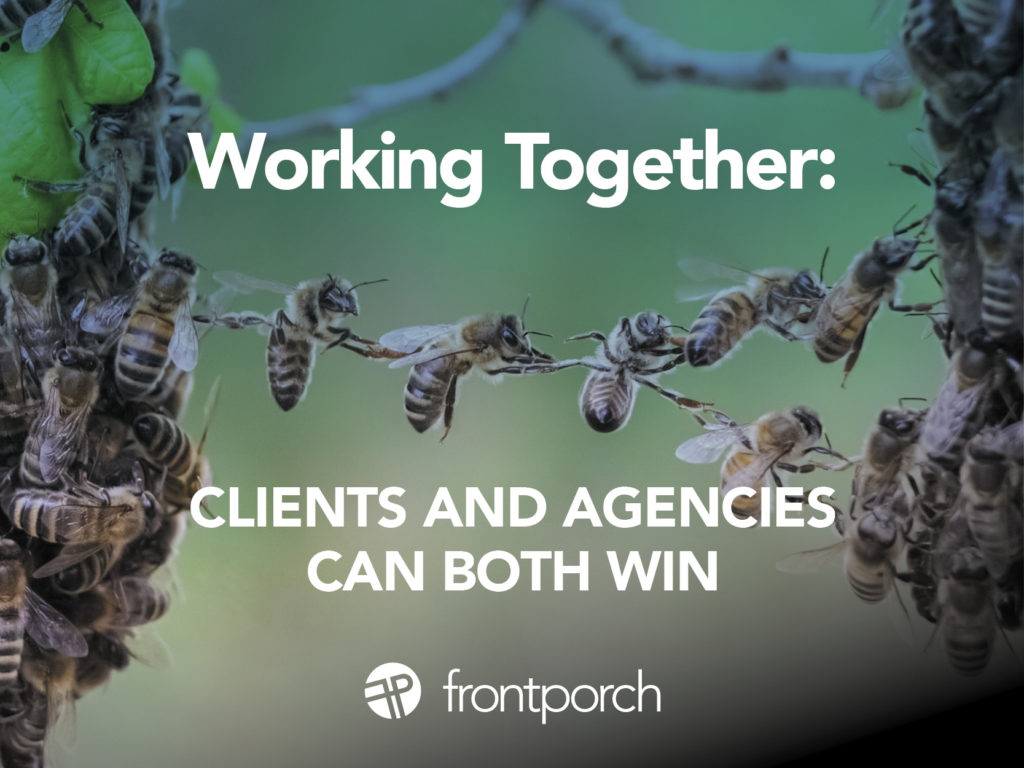
Different work styles can work together.
Whatever style you or your team members or clients chose, be kind and carry on. You CAN work together! Remember professionals of all industries and levels are going through AHAs and WHOAs of their own as 2022 progresses. It may take some people time to settle in to their optimum work style, and make it work for their family, their team, and their company.
When you’re working together, the key to a successful partner relationship between an agency and an in-house marketing client is articulating goals on both sides. What does the in-house marketing director want out of the partnership? What role(s) will the agency fill? And for those on the agency side: what is the expertise that you are offering and how will it fit into the work and process of the in-house marketing department. Ultimately, what common goal is everyone working toward?
3 traits of a successful in-house marketing director (when working with an agency):
Treat the agency like a partner. Be available. Share the wins and the losses. Exchange information and best practices. Work united toward a common goal.
Let people do their job. It has been said many times – surround yourself with smart people and let them do their jobs. This is very true when working with an agency. You, as the in-house marketing director, know your brand better than anyone. But the agency will have deep knowledge in how to market your brand to the right people, at the right time, and in the right place. Take advantage of this expertise.
Be clear, concise and direct. Communication is key to a great in-house/agency working relationship. Having clear goals and being able give good feedback will make the process of creating great work run smoother.
3 traits of a successful agency (when working with an in-house client):
Be transparent. Give real world examples with data and KPI results to show that you know how to do this work successfully. Show and tell your successes that relate to your new client’s business to increase their confidence in your expertise.
Flatten your organization when it comes to direct contact. Allow clients to be able to communicate directly with different members of your team if they need an opinion on a specific matter. Shielding most of your agency from the client and running everything through gate-keeping account service people prevents deeper brand knowledge and deeper connections.
Prepare to collaborate. Including your client in the creative process will not only make the working relationship work better, the client will have the opportunity to “own” the idea with you. Then, you’ll have no better champion for your idea than your client as it moves up the C-Suite approval chain.
Growing your partnership and working together – in-house and agency – requires determination. First, be determined to recognize the value of the people that you are working with. And then, be steadfast in your determination to succeed together.
Experience trends have changed for clients and customers. Its no longer just about owning your product or using your service – its about your customer’s experience with your brand. Over the last 21 months, our clients evolved themselves into digital and data enterprises. Now, all experiences for our clients and their customers involve technology to some extent. First, they use data to determine next steps in marketing and business. Then, digital insights can drive customer experiences for the better.
Re-evaluate what’s important – your consumer is doing it too.
2022 is not the year to chase all the shiny new things and add unneeded technology. It’s the year to re-evaluate what is important, and do JUST THAT. Digital is not just optional now, its what’s required for business. There is an endless sea of new digital tools, platforms and apps to use for your marketing strategy. But as clients and customers rethink business models and customer journeys, know that 50% of global consumers are re-evaluating what is important to them. They’re doing a little streamlining and optimizing in their own lives, as well as kicking what’s not working to the curb. Be the brand they keep.
Fewer tools; deeper connections.
Focusing on customers can help companies choose fewer, more precise tools that will help them garner deeper knowledge, and create a deeper connection. Getting rid of the digital tools that are not fully focused on getting to valuable customer insight will free up brand’s brain space to focus on what works. Keep an agile mindset as you continue to evaluate and streamline your marketing. This customer experience trend has brands enhancing existing tools that work based on data and analytics. They glean insights to increase customer and prospective customer engagement, loyalty and share of wallet.
Service companies like Super Inspector mine their customer reviews in real time. When the company receives the occasional 3-star rating (instead of a 5-star), the head of customer service immediately calls the customer to ask how they can right the wrong and improve in the future. Using data to improve customer experience is a very valuable practice to them. This simple process helps them form a deeper connection with their customers, inspiring repeat business. 2022 is an experience economy. It’s not just about a product or a service. Think about adding classes, educational videos, white papers to explain complex concepts. Help your customer experience your product or service and incorporate it into their lives.
Lessen the noise; increase focus.
Companies are using data and analytics to cut through all the clutter and noise and really speak to the consumer about what is important to THEM. When companies align their mission with their customers’ mission, relationships are built. Do your customers want meaning? Do they want convenience, speed, knowledge or maybe recognition? Use data to discover what it is that drives them to – or away from – your brand.
For example, our client Diamond Brand Gear is going deeper on its sustainability pillar this year, after reviewing their data. Their customers care deeply about sustainability. In fact, 91% of consumers expect companies to be socially and environmentally responsible. They’re weaving messaging and examples of their sustainability practices into their digital strategies, on social, email and website. One of their goals is committing to becoming a zero-waste factory by the end of 2022. So they’re conveying this messaging and tangible examples of their sustainability practices into their digital strategies. All to connect with their consumer, and show that they care about the same things.
Make digital and data work for you.
2022 isn’t the year to slow down when it comes to digital and data. It’s time to examine some of these customer experience trends, streamline and optimize what’s working for your brand, and get rid of the unnecessary. From using chat bots on SMS to help your company with customer service. From adding the most effective social channel, to building a monthly email newsletter. Adding a blog to adding a layer of transparency to your website regarding the way your company does business. Digital tools and analytic data from your customers can help you be a better company to them. Apply this valuable knowledge to client and customer experiences across the board in your company, and build a deeper connection with your customers this year.